
Why the shaded side of your driveway seals differently than the sun side
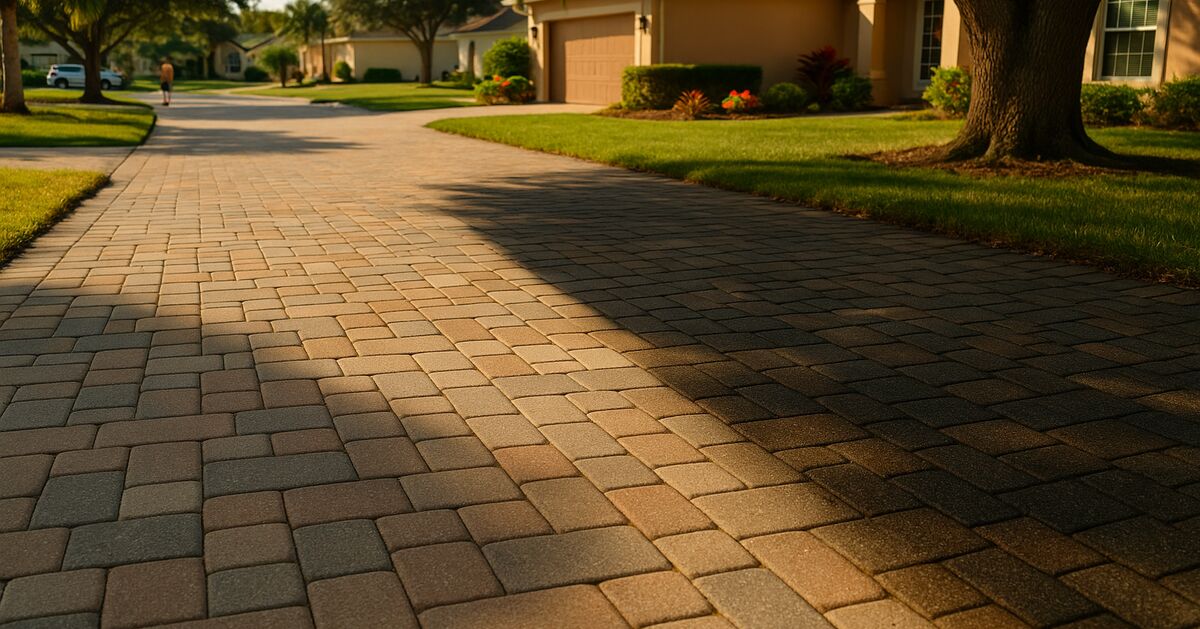
Flip your garden hose on the shaded half of your driveway and the sun-baked half at the same time, and watch what happens. The sunny side dries in minutes. The shaded side stays damp for hours. That single difference sets off a chain reaction that changes almost everything about how sealer behaves, how long it lasts, and how it looks when the job is done.
This is one of those details that separates a rushed sealing job from a professional one, and homeowners across Lakewood Ranch, Sarasota, Venice, and Bradenton often run into the consequences: half the driveway looks crisp and protected, the other half looks hazy, peels early, or turns green again within a season. Here is exactly why it happens and how it gets fixed properly.
The physics behind the shade-sun divide
Paver sealer is a coating. Like any coating, it needs to bond to the surface it goes onto. That bond depends heavily on two things: surface temperature and surface moisture content.
On the sun-exposed side of a typical Gulf Coast driveway, concrete or brick pavers can reach surface temperatures well above 100°F on a summer afternoon, and even on mild winter days they warm up quickly after sunrise. The U.S. Department of Energy notes that dark-colored paved surfaces in sunny climates can be 50 to 90°F hotter than ambient air temperature during peak sun hours. That heat drives moisture out of the paver body fast, leaving a dry, warm surface that solvent- and water-based sealers can penetrate and grip.
The shaded side sits at a lower surface temperature all day long. In Florida's high-humidity climate, where the National Weather Service regularly records relative humidity above 80 percent in the morning hours across Sarasota and Manatee counties, a cool shaded surface acts almost like a condensation collector. Moisture wicks up from the sub-base, lingers on the surface, and does not flash off quickly. Apply sealer over a damp paver and the sealer cannot penetrate properly. Instead, it sits on top of a thin film of water, traps that moisture underneath, and eventually turns milky white or begins to peel. (If you have already experienced that exact problem, the companion post on sealing over old sealer without stripping: the exact failure modes goes deeper on the chemistry.)
Biological growth: a shaded surface problem
Temperature and moisture do more than affect sealer adhesion. They create a living ecosystem on the paver surface.
Algae, mold, lichen, and moss all prefer shaded, moist environments. The EPA's guidance on biological growth on building materials confirms that surfaces that stay damp for extended periods are significantly more susceptible to microbial colonization than surfaces that dry quickly after rain. On a typical Gulf Coast driveway with tree canopy or a second-story overhang on one side, the shaded pavers can stay biologically active year-round, while the sunny side dries out between rain events and suppresses growth naturally.
This matters for sealing because you cannot seal over live biological growth and expect good results. The sealer will bond to the algae film, not the paver. As the organic material beneath continues to grow and die, the sealer lifts with it. Within a season you are looking at patchy, flaking sealer that actually traps more moisture than bare pavers would.
Owners with lake-view or pond-adjacent properties face an amplified version of this problem. The post on why lake-view pavers grow algae faster covers that specific situation in detail.
How joint sand behaves differently under shade
Most paver installations use polymeric or standard sand in the joints between pavers. On the sunny side, that sand stays relatively dry between rain events. On the shaded side, persistent moisture causes sand to compact unevenly, promotes moss and weed germination in the joints, and can accelerate the breakdown of polymeric sand's binding agents over time.
Before any professional sealing job, the joints need to be assessed separately on each side of the driveway. It is common to find joints on the shaded side that are softer, partially washed out, or filled with green organic matter, while the sunny-side joints look nearly intact. Treating both sides identically because they are part of the same driveway is a shortcut that leads to early failure.
What the temperature gap means for sealer application timing
Professional crews who work across areas like Palmer Ranch paver sealing and restoration and Nokomis paver sealing and restoration develop a feel for timing that simply cannot be replicated by a homeowner with a weekend and a bucket from the hardware store.
Here is what experienced applicators account for:
- Minimum surface temperature. Most quality solvent-based and water-based sealers specify a minimum application surface temperature, often around 50°F, and the shaded side of a driveway in a cooler month may sit below that threshold even when the sunny side is perfectly warm.
- Maximum surface temperature. High surface temperatures can cause solvent-based sealers to flash too quickly, leaving a bubbly or streaky finish. The sunny side of a Florida driveway at 1:00 p.m. in July may actually be too hot, while the shaded side is ideal.
- Relative humidity at application time. Most sealer manufacturers recommend avoiding application when relative humidity is very high, often above 85 to 90 percent. In coastal Southwest Florida, that threshold is regularly crossed in morning hours. Timing matters differently on each half of the driveway because the shaded surface holds residual humidity longer.
- Dew point. A surface temperature below the local dew point means condensation is forming on the paver, even if it looks dry. Professional crews check dew point, not just air temperature, before beginning.
On a practical level, this often means a crew will prep and seal the sunny side first during peak morning hours, then return to the shaded side after it has had time to dry fully, sometimes working the two areas in different passes or even on different days if conditions require it.
The cleaning and prep difference
Prep work is where the biggest difference shows up in labor and materials.
For the sun-exposed side, standard pressure washing typically removes surface dirt, old sealer residue, and light biological staining efficiently. The surface dries quickly after washing, and the crew can assess the paver condition clearly.
For the shaded side, the prep sequence is often more involved:
- Biological treatment. A diluted biocide or algae-specific cleaner is applied and allowed to dwell long enough to kill the growth at the root level, not just bleach the surface appearance. The EPA recommends following label directions carefully for any biocide product used near landscaping or stormwater drainage.
- Pressure washing. After the dwell time, pressure washing removes the dead organic material. Shaded pavers often require a second pass or a lower tip angle to lift embedded algae from the paver face texture.
- Extended dry time. This is the step that DIY jobs most often skip. The shaded side may need 24 to 48 additional hours of dry time beyond what the sunny side needs. In high-humidity periods common to Bradenton and Sarasota in summer, that window can extend further. Sealing too soon is the direct cause of white haze and early peeling on shaded pavers.
- Joint inspection and repair. Shaded joints are refilled or topped up with appropriate sand before sealing.
Sealer product selection: does shade change the formula?
This question comes up often, and the honest answer is nuanced.
The same sealer product can be applied to both sides of a driveway. What changes is not necessarily the product but the film thickness, the number of coats, and the application method.
Shaded pavers that stay cooler and collect more moisture benefit from a sealer applied in thinner coats with more drying time between coats. Applying a heavy wet coat on a shaded surface traps solvent or water beneath the film and leads to the milky appearance that owners then blame on a "bad product." The product is usually fine. The application was not calibrated for those surface conditions.
Some professional applicators do select a sealer with slightly different open time characteristics for shaded areas, choosing a formula that stays workable longer at lower temperatures. This is a judgment call based on the specific product lines a company uses regularly and the ambient conditions on the day of the job. It is not something that shows up in a product brochure, it comes from doing this work repeatedly in Gulf Coast conditions.
If you are curious about how sun exposure specifically accelerates degradation on the sunny side of your driveway, the post on UV and your driveway explains the photochemical process in plain terms.
What homeowners in new Gulf Coast communities should watch for
Many newer builds in Wellen Park and Lakewood Ranch have driveways that sit in full sun for the first year or two, then develop significant shade as installed landscaping matures. That transition changes the maintenance picture completely. A sealing schedule that worked fine when the palms were small may start producing uneven results as the canopy fills in and creates a permanent shaded zone over part of the driveway.
The post on Wellen Park paver wear and first restoration covers some of these new-construction specifics. Homeowners in Lakewood Ranch dealing with similar decisions about when and how to restore their pavers can also find relevant guidance in the Lakewood Ranch re-sand, re-seal, or full restoration breakdown.
What a professional assessment actually looks at
When a Gulf Coast Paver Sealing crew visits your property before a job, they are not just looking at square footage. On a driveway with mixed sun and shade, the walkthrough includes:
- Mapping which sections receive direct sun and for how many hours per day
- Noting the direction of prevailing afternoon shade (typically from the west side of a garage or tree line)
- Checking joint sand condition separately in each zone
- Assessing current biological growth coverage and its depth into the paver texture
- Checking for any standing water or drainage issues that keep certain pavers wetter than others
- Looking at the existing sealer condition (if any) to see if shade zones show more cloudiness or peeling than sun zones
That information directly shapes the prep plan, the timing of application, and the choice of application technique for each zone. It is also why a professional quote for a shaded driveway might involve more labor hours than a homeowner expects based purely on square footage.
You can explore the full scope of what our process involves on the paver sealing and restoration services page, or reach out directly through the contact page to schedule a no-pressure site visit.
A common scenario on Gulf Coast driveways
A pattern that comes up again and again in owner conversations is this: a homeowner has their driveway sealed by a budget crew that treats the whole surface identically. Six months later, the sunny half still looks good. The shaded half has turned hazy or is already growing algae again under a partially peeling coat. The homeowner assumes the sealer itself was the problem and buys a different brand for the next attempt. The brand was not the issue. The prep and timing on the shaded zone were the issue.
Stripping and resealing shaded pavers that were sealed incorrectly is a more involved job than doing it right the first time. That is worth keeping in mind when comparing quotes.
The takeaway
Your driveway is not one surface. It is two (or more) microclimates sitting side by side, with meaningfully different moisture levels, biological activity, and temperature profiles that directly affect how sealer bonds, cures, and lasts. A professional approach treats each zone on its own terms, adjusting prep intensity, dry time, and application technique accordingly.
Across our service areas from Venice and Nokomis up through Bradenton and Parrish, the same conditions apply: Gulf Coast humidity and lush landscaping mean many driveways have a sun-shade split worth taking seriously. Getting the prep right on the shaded side is the single biggest factor in whether a sealing job holds up evenly across the whole surface for years, or starts showing problems on one half within a season.
Sources & further reading
- Heat Island Effect: Paved Surfaces and Surface Temperatures (U.S. Department of Energy)
- Mold and Moisture - Biological Growth on Building Materials (U.S. Environmental Protection Agency)
- Relative Humidity and Dew Point Climatological Data, Southwest Florida (National Weather Service / NOAA)
- Pesticide and Biocide Product Label Requirements (U.S. Environmental Protection Agency)
- Florida Climate Center - Humidity and Precipitation Data (Florida State University Florida Climate Center)
Claim-by-claim audit (6 checked)
- “The U.S. Department of Energy notes that dark-colored paved surfaces in sunny climates can be 50 to 90°F hotter than ambient air temperature during peak sun hours.” (cited → energy.gov)
- “In Florida's high-humidity climate, where the National Weather Service regularly records relative humidity above 80 percent in the morning hours across Sarasota and Manatee countie…” (cited → weather.gov)
- “The EPA's guidance on biological growth on building materials confirms that surfaces that stay damp for extended periods are significantly more susceptible to microbial colonizatio…” (cited → epa.gov)
- “The EPA recommends following label directions carefully for any biocide product used near landscaping or stormwater drainage.” (cited → epa.gov)
- “Most sealer manufacturers recommend avoiding application when relative humidity is very high, often above 85 to 90 percent.” (rewritten to what the article can stand behind)
- “Most quality solvent-based and water-based sealers specify a minimum application surface temperature, often around 50°F, and the shaded side of a driveway in a cooler month may sit…” (reasoning shown in the article)
Get started
Request a free quote
Tell us what you need. No pressure, and a real person gets right back to you.