
Why lake-view pavers grow algae faster - and whether sealing helps
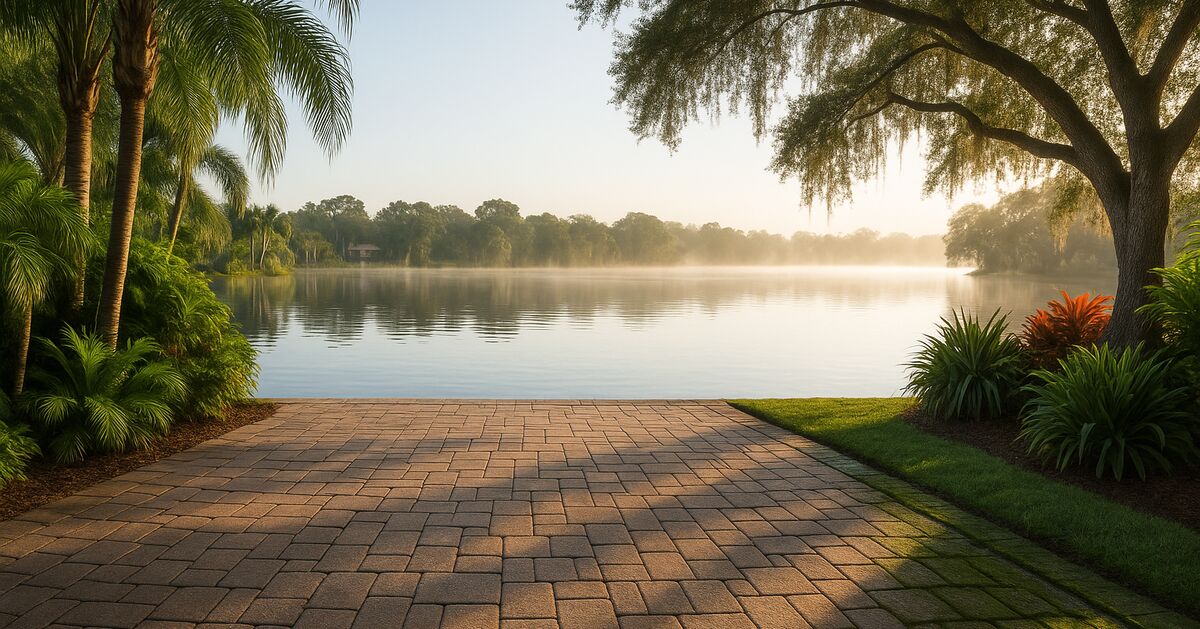
Algae shows up on almost every paver surface in Southwest Florida eventually, but if your home backs up to one of the ponds or lakes in Wellen Park, Lakewood Ranch, or another waterfront community, you've probably noticed the green and black creep starting noticeably sooner than your inland neighbors deal with it. That's not bad luck or a dirty driveway. It's physics, biology, and Florida weather working together in a very specific way.
This post breaks down why waterfront and lake-view pavers are so much more vulnerable, what algae and mildew actually need to take hold, and whether a quality paver sealer genuinely slows the cycle down or just delays the inevitable.
What algae and mildew actually need to grow on pavers
Before diving into the waterfront specifics, it helps to understand what these organisms are looking for. Algae, mildew, and the dark biofilm you often see on pavers are not random. They need a few reliable ingredients:
- Moisture - specifically, surfaces that stay damp longer than they stay dry
- Warmth - Southwest Florida's year-round temperatures are basically a growth incubator
- Organic material - dust, pollen, and airborne particles that settle into paver pores and joint sand
- Low or indirect light - shaded and partially shaded areas are especially vulnerable, but even full-sun pavers get colonized on their north-facing sides and under overhangs
Concrete and natural stone pavers are porous by nature. That porosity is what makes them grip well underfoot, but it's also what gives algae and mildew a home. Spores land, find a pocket of trapped moisture and a bit of organic debris, and they start spreading. In a dry inland environment, surfaces dry out fast enough to interrupt that cycle often. In a waterfront setting, they almost never do.
Why the lake or pond next door changes everything
Communities like Wellen Park and Lakewood Ranch were designed around water. The lakes and retention ponds that make those neighborhoods so attractive also create a microclimate that is measurably different from just a mile or two inland.
Ambient humidity is consistently higher near open water. During the day, water evaporates. That water vapor stays close to the surface of the lake, and it doesn't go far. The homes immediately adjacent to that open water sit in air that is noticeably more humid, even on days when the rest of Sarasota or Venice would feel relatively comfortable. Pavers absorb that ambient moisture from the air, not just from rain.
Morning dew is heavier and lingers longer. On lake-facing surfaces, condensation forms earlier in the evening and persists well into the morning. Pavers that might dry off by 8 or 9 a.m. at an inland property on Palmer Ranch might still be visibly damp at 10 or 11 a.m. on the lake side of a Wellen Park home. That extra hour or two of surface moisture repeated every single morning of the year adds up dramatically.
Prevailing breezes carry more moisture. The Gulf Coast gets consistent onshore flow, and communities built around lakes get an additional layer of that effect from the water body right next door. Even gentle breezes across an open lake carry elevated moisture that keeps paver surfaces primed for biological growth.
Shade from mature trees compounds the problem. Many of the established neighborhoods in Lakewood Ranch and around the Sarasota Bayfront have significant tree canopy, and lake-view lots often have that canopy on the north or east side of the home. Shaded pavers lose moisture even more slowly and receive less UV light, which is one of algae's natural enemies.
Airborne organic matter accumulates faster. Lakes attract birds, insects, and plant life. Pollen from lakeside vegetation, bird droppings, and organic particulates all settle onto paver surfaces at higher rates near open water. That gives algae and mildew a richer food source to work with.
The result is a surface that is almost always slightly damp, regularly receiving organic nutrients, and not drying out reliably. Algae and mildew love this combination, and they move quickly.
The difference between green algae and black mildew
Homeowners sometimes use these terms interchangeably, but they behave a little differently and respond differently to treatment.
Green algae tends to appear first, especially on surfaces that get some direct sun and periodic moisture. It's the slippery greenish film you notice on a pool deck or driveway edge after a rainy stretch. It grows fast but is relatively easy to remove when caught early.
Black algae and dark biofilm (sometimes called black mold or mildew) are harder to deal with. They tend to colonize more deeply into porous materials and are often found in shaded areas, north-facing walls, and under the edges of pavers. In Nokomis and Bradenton lakefront homes, this dark staining is frequently the first complaint homeowners bring to us. It's not just on the surface. It's in the pores.
Orange and pink biological staining occasionally appears too, particularly in areas with standing water or poor drainage. This is typically a different class of microorganism but stems from the same moisture-retention conditions.
Understanding which type you're dealing with matters because it affects what cleaning approach works before sealing, and whether a surface needs a light scrub or a proper chemical treatment to be truly clean.
Does sealing actually slow algae and mildew growth?
This is the honest question homeowners want answered, and the honest answer is: yes, but with important conditions.
A properly applied sealer reduces porosity. Most algae and mildew growth happens in the open pores of concrete and stone pavers. A penetrating sealer fills or significantly narrows those pores, leaving less surface area for spores to grip and less internal space for moisture to hide. A film-forming sealer (the kind that creates a wet-look or satin sheen) creates an actual barrier on top of the paver surface. Both approaches meaningfully reduce the moisture retention that algae depends on.
Sealer doesn't kill existing growth. This is where a lot of homeowners get frustrated. If pavers are sealed over existing algae, mildew, or biofilm, the sealer traps that organic material underneath and the problem continues or worsens. This is why proper cleaning and, when needed, chemical treatment before sealing is not optional. You can read more about that process in our discussion of paver sealing and restoration services.
Sealer does slow the regrowth cycle. On clean, sealed pavers, the time between meaningful algae or mildew regrowth is meaningfully longer than on unsealed pavers in the same conditions. Near a lake in Wellen Park, that might mean going from seeing visible growth every three to four months on bare pavers to every twelve to eighteen months on sealed ones. That's not forever, but it's a real difference in maintenance burden.
Some sealers include antimicrobial additives. Higher-quality products formulated for humid climates sometimes include biocides or UV-resistant compounds specifically intended to slow biological growth. These aren't magic, but they do add another layer of protection that makes a meaningful difference in waterfront settings.
Sealer quality and application method matter enormously. A cheap sealer applied too thickly or at the wrong time of day can trap moisture rather than repelling it. That scenario actually makes algae worse. Proper application, product selection for your specific paver type, and ideal curing conditions are the difference between sealing that helps and sealing that creates new problems. Our post on how Gulf Coast heat and humidity affect paver sealer cure time goes into that in detail.
What a proper treatment cycle looks like for lake-view homes
For a waterfront property in Lakewood Ranch, Wellen Park, or Nokomis, a realistic maintenance approach has a few key steps:
- Start with a thorough chemical cleaning. Pressure washing alone doesn't kill algae spores. A proper algaecide or fungicide treatment followed by rinsing is the only way to genuinely remove biological growth rather than just relocating it. Skipping this step means sealing over live organisms.
- Address joint sand before sealing. Algae frequently colonizes the joint sand between pavers before it spreads to the paver surface itself. If that sand is loose, contaminated, or low, it needs to be replaced. Our blog on re-sanding vs. polymeric sand before sealing covers when each option makes sense.
- Let the surface dry completely. In a lakeside environment, this takes longer than you'd expect. Sealing over a damp surface is one of the most common mistakes that leads to clouding, peeling, and trapped moisture problems. The surface needs to be genuinely dry, not just surface-dry.
- Apply an appropriate sealer for your paver type and location. Penetrating sealers work well for natural stone like travertine. Film-forming sealers work well for concrete pavers and give that wet-look finish many homeowners prefer. For waterfront homes, a product with UV stabilizers and mildew-resistant chemistry is worth the extra cost.
- Reseal on a regular schedule. In a standard inland environment, resealing every two to three years is a reasonable guideline. For lake-view and waterfront properties, especially on the shaded north or east elevations of the home, checking the sealer condition every eighteen months and planning to reseal every two years is more realistic.
Why some areas of your pavers are worse than others
You may have noticed that algae doesn't spread evenly across your driveway, pool deck, or patio. The pattern is usually telling you something about your drainage, shade, and airflow.
- The edge of a driveway that runs close to lawn or mulch stays wetter because it absorbs moisture from the soil alongside it.
- The shaded north side of a lanai or entry gets far less drying sun and air movement.
- Low spots where water pools after rain take longer to drain and dry.
- Areas under tree canopy stay sheltered from UV light, which naturally inhibits algae.
Addressing those site conditions, when possible, alongside sealing gives the best long-term results. Sometimes that means improving drainage, trimming overhanging vegetation, or simply focusing cleaning and sealing attention on the highest-risk zones.
What's realistic to expect after sealing a lake-view property
We want to be straightforward with homeowners in Wellen Park, Lakewood Ranch, Bradenton, and across our full service area: sealing is not a one-time permanent solution in a high-humidity waterfront environment. Nothing is. But it is the single most effective tool for extending the life of your pavers, reducing the frequency of deep cleaning, and keeping that green and black film from taking hold quickly.
A well-sealed paver surface is easier to clean when growth does return because algae has less porous surface to grip. A pressure wash or a surface rinse with a diluted cleaner often does the job on sealed pavers, while unsealed pavers sometimes need aggressive scrubbing and chemical treatment every time.
For homeowners who are tired of the constant cycle of watching their beautiful lakefront paver driveway or pool deck turn green again just a few months after cleaning, sealing is the step that changes the math. It doesn't eliminate the work entirely in a waterfront microclimate, but it makes the work much less frequent and much less intensive.
If you're not sure whether your pavers are currently sealed, whether the existing sealer is still performing, or whether your surface needs a full restoration before sealing, our frequently asked questions page covers a lot of that ground. And if you'd like a professional eye on your specific situation, reaching out for a consultation is always a good starting point. Our team works regularly with lake-view homeowners throughout Wellen Park, Lakewood Ranch, and the surrounding communities and knows exactly what those microclimates demand.
Taking care of your pavers near the water is a little more demanding than it is inland. But with the right approach, those surfaces can look great and stay safer underfoot for years between major interventions.
Get started
Request a free quote
Tell us what you need. No pressure, and a real person gets right back to you.