
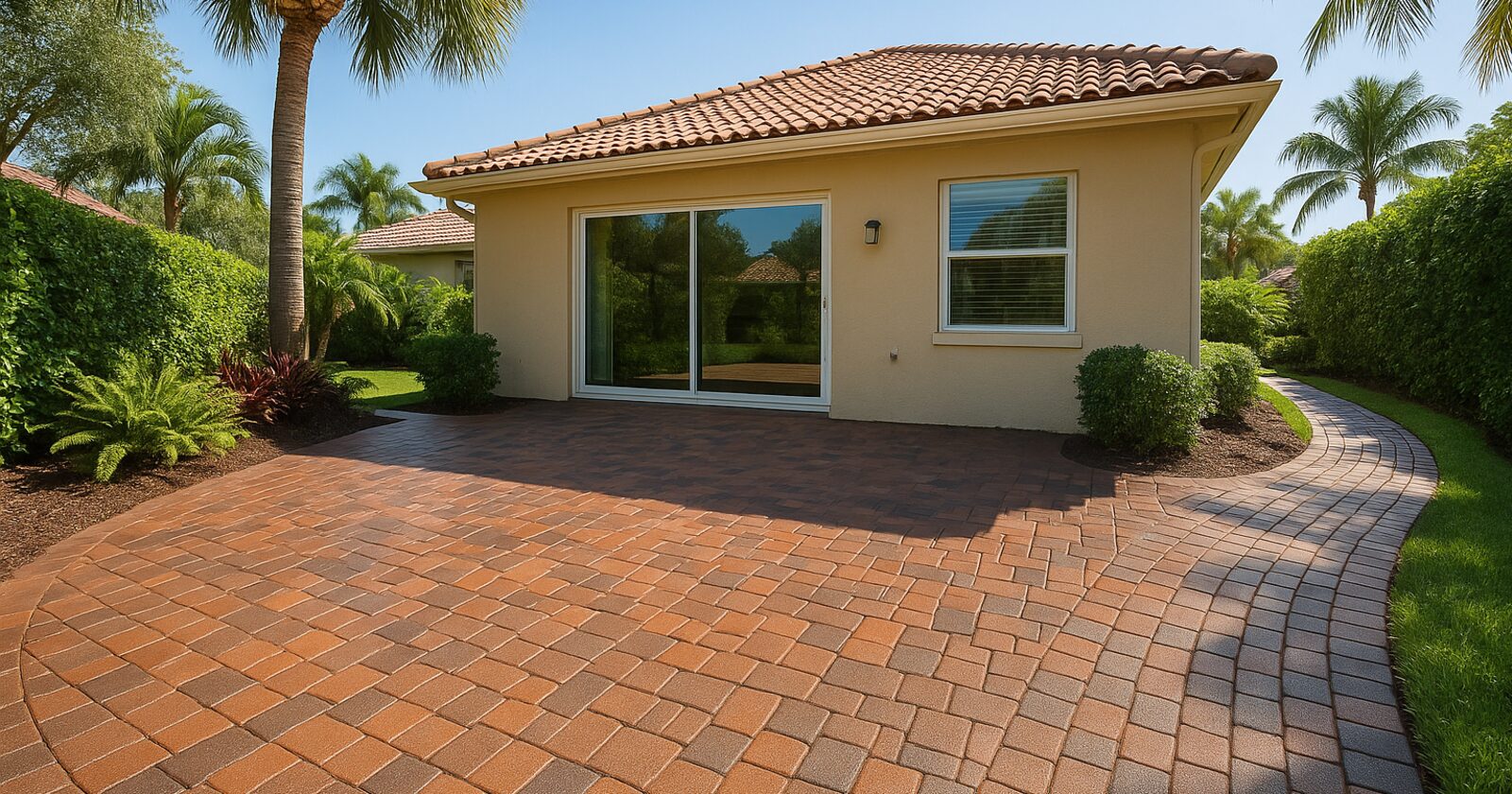
Not every paver surface needs replacing. Most just need restoring. If your driveway, walkway, or patio has weeds pushing through the joints, sand washing away after every storm, or a few sunken or shifted pavers, we can bring it back. We pull the weeds and old joint material, reset and relevel the problem areas, sweep in fresh polymeric sand, and seal the whole surface so it's tight, even, and protected again. It's a fraction of the cost of a tear-out, and the result looks and performs like a new install.
Paver Restoration in Sarasota and Manatee County
There is a point where a paver surface is past the help of a routine clean and reseal. The pavers have started to sink in spots, weeds and ants have taken over the joints, the color has gone flat and gray, and an old coat of sealer is peeling up in cloudy patches. When a driveway, patio, or pool deck reaches that stage, what it needs is not another quick wash. It needs restoration. That is the work we do at Gulf Coast Paver Sealing, and it is the difference between a surface that looks passable for a season and one that looks and functions like new for years.
We serve homeowners across Sarasota and Manatee County, and we see the same story again and again. A beautiful paver installation goes in, gets a few years of sun and rain and foot traffic, and slowly slides downhill because nobody maintained it. The good news is that pavers are built to be brought back. Unlike a poured slab that cracks and stays cracked, a paver surface can be lifted, re-leveled, re-sanded, and resealed so that the same stones you already own look better than the day they were laid. Restoration saves you the enormous cost of a tear-out and reinstall, and it respects the investment you already made.
Signs your pavers need restoration, not just a reseal
The clearest sign is movement. If you have pavers that have sunk into a low spot, lifted up at an edge, or rock under your foot when you step on them, sealing over that will not fix anything. The base underneath has shifted, and the surface needs to be lifted and re-leveled before anything else happens.
Washed-out joints are another telltale sign. The sand between your pavers is structural. It locks the stones together and keeps them from sliding. When you can see gaps, when the joints sit well below the top of the pavers, or when sand washes across the surface every time it rains, the joint sand is failing and needs to be fully replaced, not just topped off.
Heavy weeds and ant hills coming up through the joints tell the same story. Weeds and ants move in when the joint sand is old, loose, or gone. You can pull weeds all day, but until the joints are properly cleaned out and re-sanded with the right material, they will keep coming back.
Then there is the surface itself. Deep staining from rust, oil, leaf tannin, or organic buildup, color that has faded to a washed-out gray, an old sealer that has turned cloudy, white, or is flaking and peeling, and green or black algae spreading across shaded areas near the pool or under trees. Any one of these on its own might be a cleaning job. Several of them together, especially combined with movement or failing joints, means the surface is ready for full restoration.
What our restoration process includes
We treat restoration as a step-by-step rebuild of the surface, and we do the steps in the right order. Skipping steps or doing them out of sequence is why a lot of paver work does not last.
Assessment comes first. Before we quote anything, we walk the whole surface with you. We look for low spots and lifted areas, we check how water drains and where it pools, we test how much old sealer is present and whether it has failed, we note broken or cracked pavers, and we figure out what is causing any movement. Sometimes the problem is a washed-out base, sometimes it is a tree root, sometimes it is a downspout dumping water in one spot. We want to understand the real cause before we touch anything, because fixing the surface without fixing the cause is a waste of your money.
Lifting and re-leveling is where real restoration separates itself from a wash-and-seal. Where pavers have sunk or dipped, we lift them, correct the base underneath, re-compact and re-screed it to the proper slope, and reset the pavers so the surface is flat and drains the way it should. If the base has washed away or was never right to begin with, this is where we fix it. This is the step that eliminates trip hazards and standing water, and it is the step most quick operators skip entirely.
Replacing cracked and broken pavers comes next. Pavers that are cracked, spalling, or badly chipped get pulled and swapped out. We work to match the replacements to your existing pavers as closely as possible in size, texture, and color.
Stripping old failed sealer is necessary whenever a previous coat has gone cloudy, is peeling, or is trapping moisture. You cannot put fresh sealer over failed sealer and expect a good result. It will not bond, and the old problems show right through. When we find failed sealer, we strip it properly so we are working with a clean, sound surface.
Deep cleaning and stain treatment follows. This is far more than a pass with a pressure washer. We deep clean the pavers to pull out ground-in dirt, algae, mildew, and organic growth, and we treat specific stains such as rust, oil, battery acid marks, and leaf tannin with the right products for each. The goal is to get the pavers back to their true color, not just knock the surface film off.
Full joint re-sanding is one of the most important steps for how long the whole job lasts. We remove the old failed joint sand and refill the joints with fresh sand, using polymeric sand where it is the right choice. Polymeric sand hardens in the joints, locks the pavers together, resists washout in heavy rain, and makes it much harder for weeds and ants to get established. On certain surfaces a different sand is the correct call, and we use what is right for your specific pavers and application.
Finishing with a fresh seal ties it all together. Once the surface is level, repaired, clean, and re-sanded, we apply a quality sealer. Sealing locks the new joint sand in place, brings out and protects the paver color, guards against future staining, and slows down the return of algae and weeds. A proper seal on a properly restored surface is what buys you years of easy maintenance instead of another decline.
Why Florida is hard on pavers
Our sandy Gulf Coast soil is a big part of why pavers shift and dip here more than they do in other parts of the country. Sandy soil moves and drains differently than clay, and it can wash out from under a paver base when water is not managed well. Add our heavy summer rains and afternoon storms, which push a huge volume of water across and under these surfaces in a short time, and you have real erosion pressure on the base beneath your pavers.
Settling is the other factor. Over the first several years, the ground under any installation settles, and it rarely settles perfectly evenly. Tree and shrub roots grow under driveways and patios and push pavers up. All of this is normal for our area, and it is exactly why restoration exists. It is not a sign that your pavers were bad. It is what our soil, our rain, and our landscaping do to any paver surface over time.
Restoration fixes function, not just looks
It is easy to think of paver work as cosmetic, but the most valuable part of restoration is often the part you cannot see in a photo. When we re-level a sunken run of pavers along a walkway, we are removing a trip hazard that could hurt someone. When we correct the slope on a patio that has been pooling water against the house, we are protecting your foundation and getting rid of the standing water that breeds mosquitoes and grows algae. When we rebuild washed-out joints with polymeric sand, we are stopping the slow erosion that would otherwise keep pulling the whole surface apart. Yes, the surface ends up looking beautiful. But it also ends up safer and draining correctly, and that is the part that protects your home and the people using the space.
Matching pavers and discontinued colors, honestly
When pavers need replacing, matching them is part of the craft, and we are straight with you about it. If your paver line is still made, we source the closest match we can and place replacements thoughtfully. If your color has been discontinued, which happens often with older installations, we tell you plainly and walk through the options. Sometimes we can pull matching pavers from a hidden area, like under a grill or along a bed edge, and put the slight mismatches there instead. Sometimes a very close current product blends in well once everything is cleaned and sealed to a uniform tone. What we will not do is promise a perfect match we cannot deliver and leave you surprised on job day. You will know what to expect before we start.
Careful restoration versus a quick pressure-wash
Anyone with a pressure washer can make pavers look better for a week. Blasting the surface hard can even strip out what is left of the joint sand and damage the face of the pavers, which leaves you worse off than before. A quick wash does nothing about sunken areas, failing joints, broken pavers, or old peeling sealer. It hides the real problems just long enough for the check to clear. Careful restoration addresses the causes: the base, the joints, the damaged stones, and the failed sealer. That is why our results hold up while a cheap wash is back to looking tired by the next rainy season.
The payoff
When we finish a restoration, you get a driveway, patio, or pool deck that looks and functions like new. The surface is flat and safe underfoot, water drains where it should, the joints are full and firm, the color is rich again, and the fresh sealer protects all of it. With simple upkeep and a reseal down the road, that result lasts for years, and you got there without the cost and disruption of tearing everything out and starting over.
What to expect on job day
Restoration is more involved than a basic cleaning, so we set clear expectations up front. Depending on the size of the surface and how much leveling and repair it needs, the work may run more than one day, and polymeric sand and sealer need dry conditions and cure time, so we keep an eye on the weather and schedule around it. We ask that you keep vehicles and foot traffic off the area while it cures, and we tell you exactly how long that will be for your job. We protect surrounding landscaping and clean up thoroughly when we are done. You will not be left guessing about what is happening or when you can use your space again.
Our honest, firm-quote approach
We quote in writing after we have actually looked at your surface, and the number we write down is the number you pay unless we find something hidden underneath and talk it through with you first. We would rather tell you the honest scope of a restoration than lowball it and hit you with surprises halfway through. If your pavers only need a good clean and seal, we will tell you that too, because we are not interested in selling you work you do not need. If you have a tired, older, or neglected paver surface anywhere in Sarasota or Manatee County, we would be glad to take a look and give you a straight answer about what it will take to bring it back.
Get started
Request a free quote
Tell us what you need. No pressure, and a real person gets right back to you.