
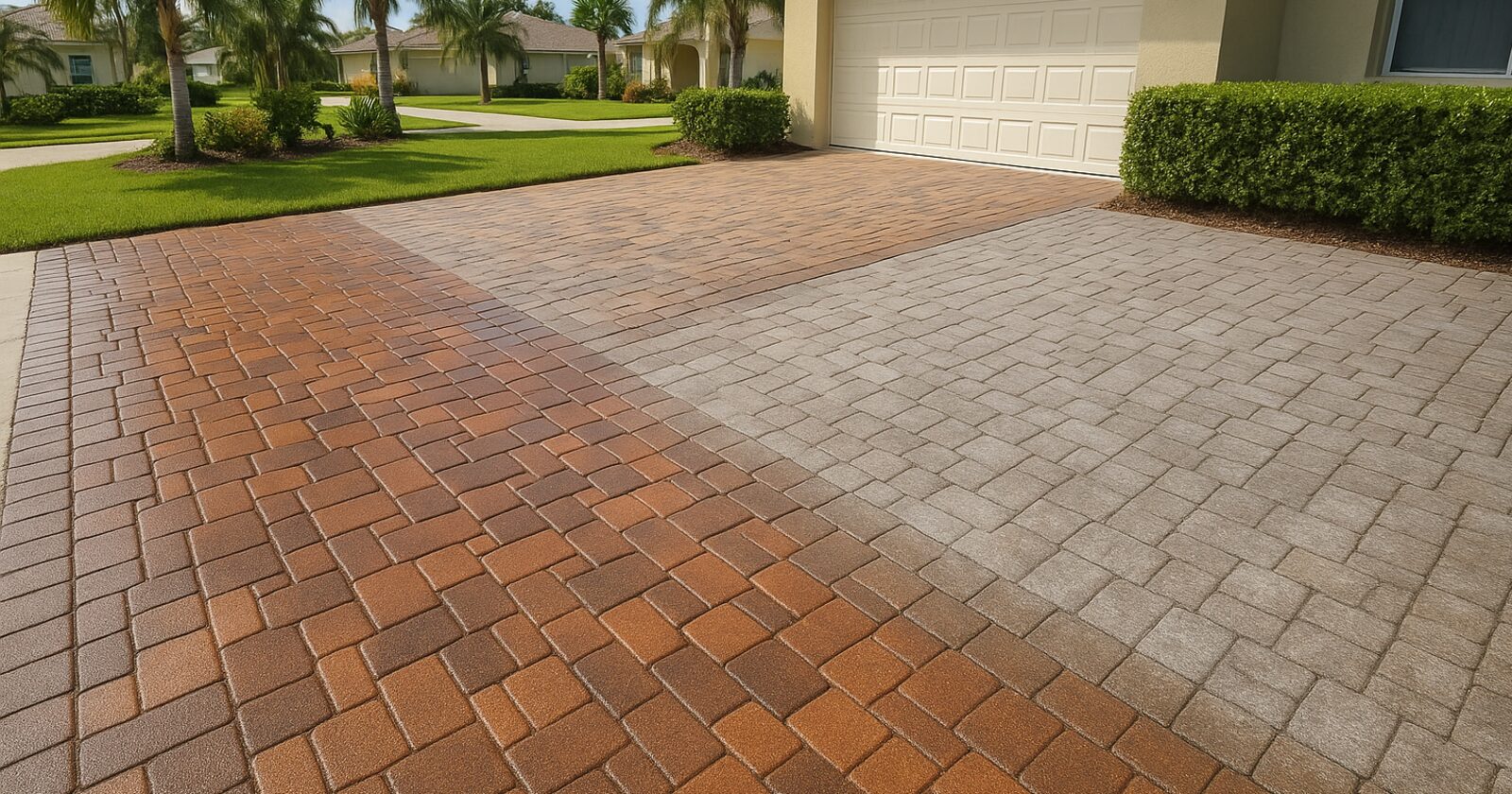
A bad seal job is worse than none. When an old sealer clouds up, turns white, peels, or gets tacky, it has to come off before anything new goes on, and that's a job most homeowners can't do themselves. We chemically strip the failed sealer, neutralize and clean the pavers, let them dry properly, and re-seal with a quality product applied at the right coverage. If a previous company left you with a hazy, blotchy, or sticky deck, this is how we fix it, so you end up with the clean, even finish you paid for the first time.
Sealer stripping is one of those jobs almost nobody plans for when they first seal their pavers. You picture a fresh, even finish that makes the color pop and holds up for years. Then somewhere along the way the sealer clouds over, peels, turns blotchy, or builds up into a hard plasticky shell that never looked quite right in the first place. When that happens here in Sarasota and Manatee County, the fix is rarely another quick coat of sealer. The real fix is to strip the failed sealer back off, get the pavers down to a clean and stable surface, and then reseal the right way. That is exactly what we do, and we want to walk you through what it involves and why it matters.
Why sealer fails or looks bad in the first place
Sealer does not fail because the pavers are bad. It fails because of what happened during or after the application, and our Gulf Coast climate is unforgiving about mistakes. The most common problem we get called about is a cloudy or milky white haze. That haze is almost always moisture trapped underneath the sealer. When sealer goes down over a surface that is still holding water, or when heavy humidity or a surprise afternoon rain rolls in before the coat has cured, the moisture gets sealed in with nowhere to escape. It shows up as a foggy white film that no amount of rinsing will remove, because the problem is under the finish, not on top of it.
Other times the finish comes out blotchy or streaky, with shiny patches next to dull ones. That usually points to uneven application, a surface that was not uniformly clean when the sealer went down, or product that started curing before it was worked in evenly. Peeling and flaking is another one we see often. The sealer lifts away in sheets or chips because it never bonded properly to the paver, frequently because there was dust, dirt, or old sealer residue between the paver and the new coat.
Then there is the plasticky, over glossy build up. This comes from too many coats layered on over the years, each one adding thickness until the surface looks less like stone and more like it is wrapped in shiny plastic. That heavy build up can trap moisture, crack, and yellow over time. Speaking of yellowing, some sealers simply amber as they age or react to sun and heat, leaving a tired, discolored cast over pavers that used to look crisp. And underneath a lot of these failures is one root cause we see again and again in Florida: sealer applied over a surface that was dirty, damp, or not fully ready.
Why you cannot just seal over failed sealer
This is the single most important thing to understand, so we say it plainly. You cannot fix failed sealer by putting more sealer on top of it. It feels like it should work. The surface looks bad, sealer is what made it look that way, so surely a fresh coat covers the problem. In practice, the opposite happens. New sealer over old failed sealer bonds to the failure, not to the paver. If there is trapped moisture causing a white haze, a fresh coat locks that moisture in even tighter and often makes the cloudiness worse. If the old sealer is peeling, the new coat peels right along with it, because it is only as stable as the layer beneath it. If there is already too much glossy build up, another coat just adds to the plastic shell.
We have been called out plenty of times to properties where someone tried the reseal over the top approach first, either on their own or with another company, and the result was a surface that looked worse and cost more to correct. Sealing over a problem does not erase it. It traps it. The only honest path back to a good looking, durable finish is to remove what has failed and start from a clean, sound surface.
What stripping actually involves
Stripping is a careful, multi step process, and doing it well is what separates a lasting result from a botched one. Here is how we approach it.
It starts with assessment. Before any product touches your pavers, we look closely at what kind of sealer is on there and how it has failed. A water based sealer behaves differently from a solvent based one, and a thin single coat strips differently from years of heavy build up. Identifying the sealer type and the specific failure tells us which stripper to use and how aggressive the job needs to be. Getting this step right protects your pavers and saves time and money down the line.
Next comes applying the correct stripper safely. Strippers are strong products by design, and the right one has to be matched to the sealer it is removing. We apply it in a controlled way, giving it the dwell time it needs to break down the old finish, while protecting the areas around the work. That means shielding your landscaping, plants, pool, screen enclosure, and any nearby surfaces that the product should never reach. This is a big part of why stripping is skilled work and not a rent a machine weekend project.
Then we agitate and remove the old sealer. Once the stripper has softened the failed finish, we work it loose and lift it off the pavers. Depending on the situation this involves mechanical agitation and rinsing to pull the dissolved sealer up and away rather than just smearing it around. Heavy build up can take more than one pass. The goal is to get the old sealer off completely, not partway, because any failed sealer left behind becomes the weak layer that ruins the next seal.
After removal comes neutralizing and thorough cleaning. Stripper residue has to be neutralized and the whole surface cleaned so nothing is left that would interfere with the fresh sealer bonding. We rinse the pavers down properly and make sure the joints and pores are clean.
Then we wait, because the surface has to dry fully. This is where patience pays off and where a lot of rushed jobs go wrong. Pavers are porous and they hold water, and in our humid climate they can look dry on the surface while still holding moisture underneath. Sealing too soon is exactly what causes the cloudy haze in the first place, so we give the pavers the time they genuinely need to release that moisture before we go any further.
Finally, we re sand the joints and apply fresh sealer correctly. Stripping and cleaning pulls sand out of the joints, so we refill them with the appropriate joint sand, lock everything in, and then apply new sealer in even, properly measured coats on a clean, dry, sound surface. That is the whole point of the exercise: a fresh start done the right way so the finish finally looks right and actually lasts.
Why this is careful, skilled work
Every step above has a way it can go wrong, and the consequences land on your property. The wrong stripper can etch or discolor pavers. Careless application can burn your plants or damage your pool finish and screen cage. Rushing the dry time bakes in the very haze you were trying to remove. Leaving residue behind guarantees the next coat fails. This is why we treat stripping as precision work and why we protect the surrounding landscaping and pool with the same attention we give the pavers themselves. Done right, stripping is restorative. Done carelessly, it can do real harm. We take it seriously.
Common causes we see around Sarasota and Manatee
Because we work exclusively here on the Gulf Coast, we see the same handful of causes over and over. Humidity and rain during a rushed application top the list. Our summer afternoons can turn from sunny to pouring in minutes, and sealer that has not cured does not forgive that. Sealing new pavers too early is another big one. Fresh pavers push out efflorescence, a natural whitish mineral haze, as they cure, and if they get sealed before that process finishes, the efflorescence and moisture get trapped under the finish. And then there is the slow build up problem, too many heavy coats added over the years by owners or companies chasing a quick refresh, until the surface is thick, glossy, and prone to trapping moisture and yellowing. None of these are exotic. They are just the predictable result of our climate meeting a job that was not given the care it needed.
When stripping is the right call versus a light refresh
We do not push stripping on people who do not need it, because it is more involved than a maintenance reseal and we would rather be straight with you. If your existing sealer is fundamentally sound and simply looking a little tired or dull, a proper cleaning and a fresh maintenance coat, a light refresh, is often all it takes. Stripping is the right call when the sealer has genuinely failed: a stubborn white or cloudy haze, peeling and flaking, blotchy or streaky finish, or a thick plasticky build up that has gone glossy or yellow. Those are problems that live in the sealer layer itself, and no refresh can fix a layer that has to come off. When we assess your pavers, we will tell you honestly which situation you are in.
What to expect on job day
When we come out to strip and reseal, we set up to protect the areas around the work first, then apply the stripper and give it the time it needs to break down the old finish. You will see us agitate and remove the softened sealer, sometimes over more than one pass on heavy build up, then neutralize and clean the whole surface. After that the pavers need to dry fully, which is a real and necessary pause in the process rather than downtime we can skip. Once the surface is genuinely ready, we re sand the joints and apply fresh sealer in even coats. Because drying is weather dependent and non negotiable, the reseal portion often falls on a separate visit, and we will lay out the realistic timeline for your specific project up front so there are no surprises.
Our honest, firm written quote approach
We quote sealer stripping the same way we handle everything else: we come look at your actual pavers, identify the real condition of the sealer, and give you a clear, firm written quote for the work that needs doing. No vague ranges that balloon later, no upselling you into stripping when a refresh would serve you fine, and no pretending a coat over the top will fix a failure that it will not. If your pavers need to be stripped and resealed, we will tell you, explain why, and put a straight number in writing. If they do not, we will tell you that too. Our goal is a finish you are genuinely happy with and a surface set up to last, and that starts with being honest about what your pavers actually need. If you are looking at cloudy, peeling, blotchy, or over glossy pavers anywhere in Sarasota or Manatee County, we would be glad to take a look and give it to you straight.
Get started
Request a free quote
Tell us what you need. No pressure, and a real person gets right back to you.