
Your driveway looks clean but UV is already winning
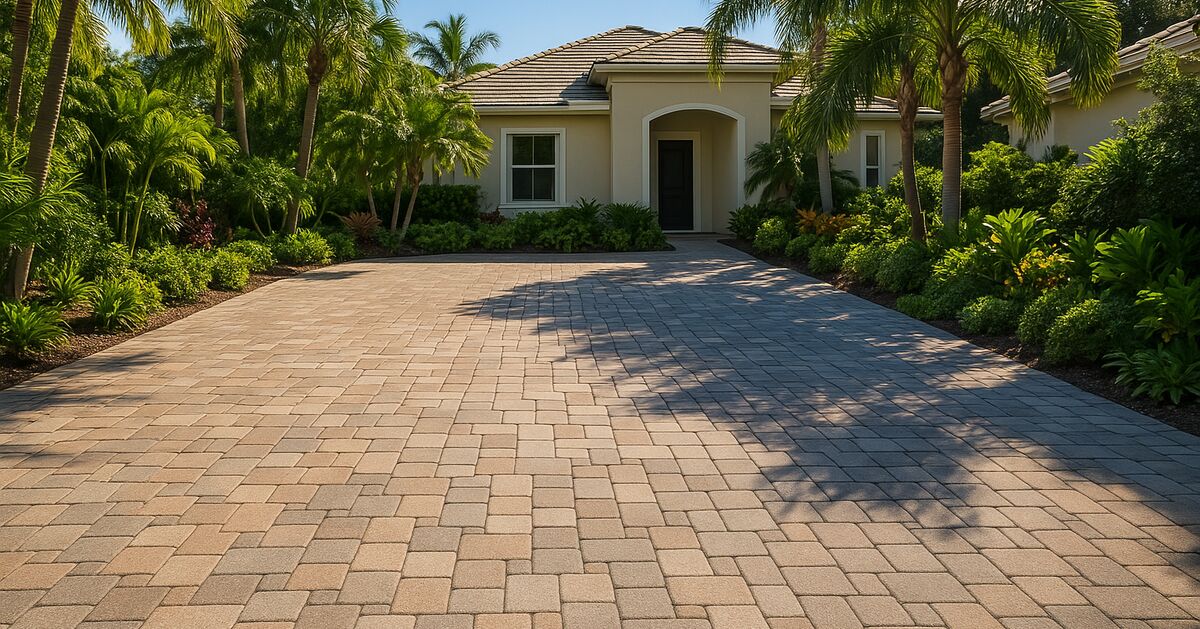
Florida sun does not wait for your pavers to look bad before it starts doing damage. A driveway in Lakewood Ranch or Wellen Park can appear clean, solid, and perfectly fine on a Saturday morning while UV radiation has already been quietly breaking down the binder material inside every paver for years. By the time the color shift becomes obvious, the surface structure has been compromised for a while. This post is about learning to read the early signs, understanding the physics of what is actually happening, and knowing why sealing is relevant long before a paver looks like it needs help.
What UV radiation actually does to concrete pavers
Concrete pavers are made from Portland cement, aggregate (crushed stone or sand), and pigment. The cement paste that holds everything together is not naturally resistant to ultraviolet radiation. When UV light hits an unsealed paver surface repeatedly, it does two things at the molecular level that matter to homeowners.
First, it breaks down the calcium silicate hydrate compounds in the cement paste. These compounds are what give concrete its strength and its relatively smooth, dense surface. As UV degrades them, the surface becomes more porous and powdery, a process sometimes called "chalking" in the concrete industry. According to the Cement Association's guidance on cracking in concrete flatwork, surface scaling and dusting are often tied to the gradual breakdown of the cement paste layer, a process that UV and thermal cycling both accelerate.
Second, UV attacks the pigment molecules used to color pavers. Pigment fading in concrete is not simply about sun bleaching the surface like a fabric. UV energy breaks the chemical bonds in iron oxide and synthetic pigment compounds, changing the molecules themselves so that they reflect different wavelengths of light. The original color is not coming back through cleaning or scrubbing, because the pigment is chemically altered, not just covered by dirt.
The Gulf Coast intensifies both processes. Southwest Florida's UV Index often reaches the "very high" to "extreme" range on summer afternoons, per the EPA's UV Index scale. Pavers in Sarasota, Venice, and Palmer Ranch absorb that energy day after day with almost no seasonal relief, unlike pavers in northern states that get months of lower-angle, lower-intensity sun. Our paver sealing and restoration services are built around this specific regional reality.
What "early UV damage" looks like on a clean driveway
This is the part that trips up a lot of homeowners. Early UV damage does not look like damage. Here is what to actually look for when you walk your driveway on a dry, sunny day.
Color that has gone "flat" or chalky
Fresh concrete pavers have a subtle sheen even without sealer, because the surface is dense and smooth. A paver that has been losing its cement paste layer will look duller and more matte than it did originally, even when clean. Run your finger across the surface. If you pick up a faint white or grey residue on a colored paver, that is surface chalk, a sign that the topmost layer of cement paste has broken down. The paver is still structurally sound, but the degradation has begun.
Color variation that was not there before
UV does not hit every paver equally. Pavers in the direct sun path for eight-plus hours fade faster than pavers partially shaded by a car, a tree, or an overhang. If your driveway has started to show a patchwork of slightly different shades, where some pavers are noticeably lighter or more washed-out than neighbors just a foot or two away, UV is the likely explanation. The pattern follows the sun, not the traffic.
The "water test" reveals porosity
Pour a small cup of water on a dry paver and watch what happens. On a dense, sealed, or UV-undamaged paver, water beads up or sits on the surface for a moment before slowly absorbing. On a paver that has lost surface density to UV degradation, water absorbs almost immediately, within one to three seconds. That fast absorption means the surface is now acting like a sponge, and everything that lands on it, motor oil, tannins from oak leaves, rust from metal furniture, and fertilizer from lawn overspray, is going in deeper and faster than it would on a fresh surface.
Sand loss at the joints
This one surprises people because it does not seem related to UV. Here is the connection: UV degrades the cement paste at the paver's edges just as it does at the face. As the edge material becomes more friable, joint sand gradually washes away faster during rain because the edge no longer holds it as tightly. If you are seeing thin joint lines where sand once sat flush, and you have not had any unusual flooding events, UV-related edge degradation is a contributing factor worth taking seriously. For a deeper look at how joint sand behaves on Gulf Coast driveways, our blog covers how joint sand washes out of pavers in Florida and why sealing is the fix.
Why the driveway still looks "clean"
Here is the paradox that catches homeowners off guard. UV damage produces no visible debris. There is no stain, no discoloration from a spill, no mold or algae, no obvious cracking. The paver just looks a little lighter, a little flatter, and maybe a little thinner in the joints. Homeowners look at it and think, "it just needs a good wash." So they pressure wash it, it looks great for a week while wet, and then it dries and still looks flat, because cleaning removed surface grime but the underlying cement paste is still compromised.
Algae and mold are actually easier to diagnose because they are visible. UV damage is invisible in its early stages, which is exactly why it often goes unaddressed until the paver surface is significantly degraded. By that point, restoration is more involved than a simple seal coat. Our frequently asked questions page covers what restoration typically involves versus a straightforward sealing job.
How Florida's climate compounds the UV problem
UV does not work alone on Gulf Coast driveways. Two other factors team up with it in ways that accelerate the timeline.
Thermal cycling
Sarasota and Bradenton pavers can experience large temperature swings, from very hot surface temperatures in July afternoon sun to much cooler temperatures on winter nights. According to NIST's overview of UV radiation and material degradation, repeated thermal expansion and contraction can accelerate microcracking in cement-based materials. Those microcracks give UV radiation more surface area to attack in subsequent cycles, and they give water more pathways to enter.
Humidity and moisture intrusion
Once UV has opened up the surface texture, moisture moves in and out with every rain and dry cycle. In a humid climate like ours, that moisture carries dissolved minerals that contribute to efflorescence, and it provides a habitat for mold and algae spores that are always present in Gulf Coast air. The surface that started as a UV problem becomes a combined UV-moisture-biological problem, and it gets harder and more expensive to address with each passing season.
Homeowners in communities near water, like those along Little Manatee River in Parrish or near the bays in Nokomis and Venice, see this acceleration even more clearly. Salt-laden air adds a mild chemical component to the mix, etching the cement paste in ways that work alongside UV degradation. Our paver sealing and restoration services in Nokomis are specifically tuned to these coastal conditions.
Why sealing works as a UV barrier
A penetrating or film-forming sealer creates a physical and chemical barrier between the paver surface and incoming UV radiation. Penetrating sealers (silane-siloxane and similar chemistry) work by lining the pores and capillaries inside the paver with a hydrophobic compound. UV radiation still hits the face of the paver, but the material it would otherwise degrade is now largely protected by the sealer chemistry. Film-forming sealers (polyurethane and acrylic-based) add an actual surface layer that absorbs and reflects UV before it reaches the cement paste.
Neither type makes a paver immortal. Sealers themselves degrade under UV exposure, which is why resealing on a regular cycle is necessary in a climate like ours. But a sealed paver surface loses far less of its cement paste binder between resealing cycles than an unsealed paver loses in the same period. The practical outcome is that sealed driveways in Lakewood Ranch and Palmer Ranch retain their color depth and surface density noticeably longer than unsealed driveways a street away.
It is also worth noting that sealing a paver while it still has intact surface density is always more effective than sealing one that has already gone chalky. On a degraded surface, sealer has to work harder, penetrates unevenly, and sometimes cannot fully compensate for what has already been lost. The best time to seal is before the damage is visible, not after. Homeowners who are weighing whether their pavers need re-sanding, resealing, or a more complete restoration will find useful framing in our post on Lakewood Ranch pavers: re-sand, re-seal, or full restoration?
What to check right now on your own driveway
You do not need a professional assessment to get a preliminary read on where your driveway stands. Here is a simple checklist to run through on a dry afternoon.
- Chalk test: Rub your palm across several pavers in the sunny section of the driveway. Pick up a residue on a colored paver? UV chalk is present.
- Water absorption test: Pour about half a cup of water on a dry paver. Time how quickly it absorbs. Under three seconds is a sign of significant surface porosity.
- Color comparison: Compare the pavers that sit fully in the sun to those under shade or a car. A visible difference in shade or depth of color is an early UV signal.
- Joint width: Kneel down and look along the joint lines. If you can see a clear gap or thinning of sand in exposed areas versus shaded areas, edge degradation is occurring.
- Age check: If your pavers were installed more than three to five years ago and have never been sealed, or it has been more than two to three years since the last seal coat, consider that the sealer's UV protection is almost certainly depleted regardless of appearance.
If several of these checks point the same direction, it is time to have the surface professionally assessed before the next Florida summer adds another full year's worth of UV load to a surface that is already working without protection.
What early sealing actually prevents
Addressing UV damage early is not just about aesthetics, though color preservation is a real benefit. Sealing a driveway before significant degradation occurs prevents a chain of problems that each carry their own cost and effort.
A porous surface from UV-degraded cement paste becomes a landing pad for oil stains that penetrate deeply and are much harder to clean. It becomes a faster-growing habitat for algae and mold. It accelerates joint sand loss, which in turn allows pavers to shift slightly, creating the uneven surface and wobbling pavers that ultimately require lifting and releveling. All of those downstream problems are more expensive to address than the sealing that would have interrupted the chain at step one.
Homeowners across our service area, from Wellen Park and Venice up through Bradenton and Parrish, are dealing with driveways at different points along this timeline. Some are genuinely early and a clean-and-seal is all that is needed. Others are further along and need restoration work first. In either case, the right answer starts with an honest look at where the surface actually stands, not just whether it looks clean on a Sunday morning.
If you want a professional set of eyes on your driveway before committing to any approach, reach out through our contact page for a no-pressure assessment. We work across Sarasota, Manatee, and surrounding counties and can give you a straight answer about what your pavers actually need.
Sources & further reading
- UV Index Scale and Sun Safety (U.S. Environmental Protection Agency)
- Causes of Cracking in Concrete Flatwork (Portland Cement Association)
- Concrete and Masonry Surface Deterioration (National Ready Mixed Concrete Association)
- UV Radiation and Material Degradation Overview (National Institute of Standards and Technology)
Claim-by-claim audit (7 checked)
- “According to the Cement Association's guidance on cracking in concrete flatwork, surface scaling and dusting are often tied to the gradual breakdown of the cement paste layer, a pr…” (rewritten to what the article can stand behind)
- “Southwest Florida's UV Index often reaches the "very high" to "extreme" range on summer afternoons, per the EPA's UV Index scale.” (rewritten to what the article can stand behind)
- “According to NIST's overview of UV radiation and material degradation, repeated thermal expansion and contraction can accelerate microcracking in cement-based materials.” (rewritten to what the article can stand behind)
- “Sarasota and Bradenton pavers can experience large temperature swings, from very hot surface temperatures in July afternoon sun to much cooler temperatures on winter nights.” (rewritten to what the article can stand behind)
- “UV radiation has already been quietly breaking down the binder material inside every paver for years.” (reasoning shown in the article)
- “UV attacks the pigment molecules used to color pavers.” (cited → nist.gov)
- “These compounds are what give concrete its strength and its relatively smooth, dense surface.” (cited → nrmca.org)
Get started
Request a free quote
Tell us what you need. No pressure, and a real person gets right back to you.