
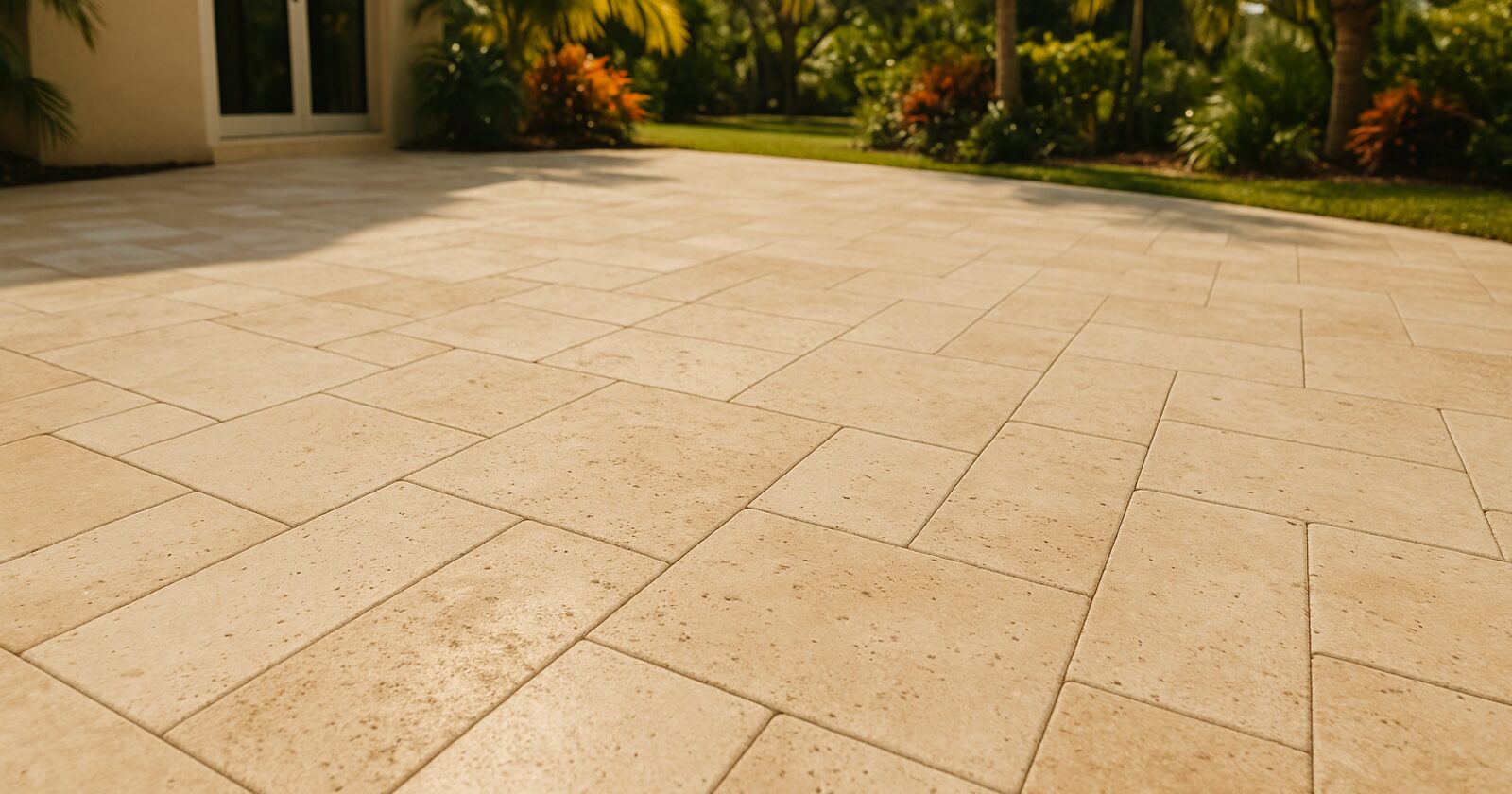
Travertine is everywhere on Sarasota and Manatee pool decks, and it needs a different touch than concrete pavers. It's a natural stone that stains, etches, and grows mildew if it's left bare, but the wrong sealer can make it dangerously slippery or trap moisture and cause it to flake. We use a breathable, penetrating sealer made for natural stone that guards against stains, hard-water spotting, and organic growth while keeping the travertine's natural look and a safe, matte surface. Your deck stays cool, clean, and protected without losing the reason you chose travertine in the first place.
Travertine Sealing in Sarasota and Manatee County
Travertine has become one of the most sought-after surfaces for pool decks, patios, and lanais across Sarasota and Manatee County, and for good reason. It is a natural stone, quarried from the earth rather than poured from a mold, and it carries a warmth and character that manufactured pavers simply cannot copy. If you have a travertine deck around your pool or a travertine patio off the back of your home, you already know how good it looks and how comfortable it feels underfoot on a hot Gulf-coast afternoon. Protecting that investment is what we do, and travertine sealing is one of the jobs we take the most care with, because getting it right requires a genuinely different approach than sealing ordinary concrete pavers.
What Makes Travertine Different
The first thing to understand is that travertine is not a paver in the usual sense. Concrete pavers are manufactured from cement, sand, and aggregate, pressed under high pressure into a dense, uniform block. Travertine is a natural sedimentary stone formed over thousands of years, and that natural origin is exactly what gives it its beauty and also what makes it more delicate to work with. Travertine is more porous and generally softer than concrete, and it comes with naturally occurring pits, pockets, and small holes across its surface. Those little voids are not defects. They are part of the stone's honest, organic look, and many homeowners specifically choose travertine because of that texture rather than in spite of it.
That porosity and softness are also why travertine stays noticeably cooler underfoot than concrete or darker pavers, which is a real advantage in our climate when the sun is beating down on a pool deck all day. The trade-off is that the same open, absorbent surface that keeps it cool also soaks up spills, pool splash, and staining agents more readily than a dense concrete paver would. Left unsealed, travertine will happily drink in whatever lands on it, and that is where problems begin.
Why Sealing Travertine Is a Different Job
We want to be direct about this, because it matters. Sealing travertine is not the same job as sealing a concrete paver driveway, and it should not be treated like one. The aggressive methods that work on hard concrete can permanently damage natural stone. Harsh acidic cleaners will etch travertine, eating into the surface and leaving it dull, cloudy, and rough where it was once smooth and bright. High-pressure washing aimed carelessly at the stone can blast out the softer material, chew up the edges, and leave visible wand marks that never fully go away. Once travertine is etched or gouged, there is no simple undo. That is why we lead with gentle cleaning methods and the correct products, calibrated for natural stone rather than borrowed from a concrete job.
The sealer itself is just as important as the cleaning. The wrong sealer, or a sealer applied the wrong way, can darken travertine unevenly, leave blotches and dark patches, or trap moisture inside the stone where it causes problems later. A film-forming product meant for concrete can sit on top of travertine and give it a plasticky, unnatural look that most owners dislike the moment they see it. We choose products formulated to work with the stone, and we apply them at the right coverage so the finish is even and predictable.
Natural-Look Versus Enhancing Sealers
One of the most important conversations we have with travertine owners is about the look you actually want to keep, because there are two honest directions to go and neither is wrong.
The first is a penetrating, natural-look sealer. This kind of product soaks into the stone and protects it from within without changing how it looks. Your travertine keeps its soft, matte, natural appearance, and the color stays essentially the way it is today. The protection is there working quietly below the surface, resisting stains and moisture, but a guest standing on your deck would never know the stone had been sealed at all. For a great many travertine owners here, that is exactly the point. They fell in love with the natural matte look and the cool, understated tone of the stone, and they want to preserve it, not transform it.
The second direction is an enhancing sealer. This deepens and enriches the color of the travertine, bringing out the warm tones and the natural variation in the stone, often giving it a slightly richer, more saturated appearance. Some homeowners love this because it makes the deck feel more dramatic and finished. Others feel it moves too far from the quiet, natural character they chose travertine for in the first place. There is no universally correct answer here, which is why we walk you through it honestly and, where it helps, show you what to expect before we commit to the whole surface. What we will not do is push you toward a glossy, color-changing finish just because it photographs well. This is your deck, and the right choice is the one you will be happy to live with for years.
Slip Safety Around the Pool
Because so much travertine around here sits directly around swimming pools, slip safety is never an afterthought for us. A pool deck is wet by definition, and the last thing anyone wants is a surface that turns slick when it gets splashed. We deliberately avoid slick, glossy film finishes on pool decks. The goal is protection that keeps traction, so the stone stays as sure-footed underfoot after sealing as it was before. This is another reason a penetrating, natural-look product is so often the right call for travertine around water. It protects the stone without laying down a slippery film on top of it.
How Travertine Handles Our Gulf-Coast Climate
Sarasota and Manatee County put natural stone through a lot. We have relentless humidity, salt air rolling in off the Gulf, frequent rain, and long stretches of heat, and all of that is hard on an open, porous surface. Unsealed travertine in this environment is vulnerable in several specific ways. Organic growth loves it, so algae, mold, and mildew take hold in the pits and shaded areas, leaving dark or greenish patches. Salt air and hard water leave mineral deposits and cloudy residue behind. Pool chemistry is another quiet threat, because chlorine, salt-system water, and other pool chemicals can etch and discolor stone over time, especially where splash-out lands in the same spots day after day. Hard water from irrigation and rinse-off leaves its own mineral staining as it dries.
Sealing helps on every one of these fronts. By reducing how much the stone absorbs, a good sealer makes it far harder for stains to set, for pool chemicals and hard water to etch and dull the surface, and for mold and algae to root themselves deep in the stone. It does not make travertine indestructible, and we would never claim that, but it gives the stone a real, meaningful layer of defense against the exact conditions our coastline throws at it, and it makes routine cleaning dramatically easier because grime sits nearer the surface instead of soaking in.
Our Service Steps
Every travertine job starts with an honest assessment. We look closely at the condition of the stone, the state of the joints, any existing staining or etching, how much sun and shade the area gets, and how it is used, so we can recommend the right cleaning approach and the right sealer for your specific deck rather than a one-size-fits-all package.
Next comes gentle cleaning. We clean the travertine using methods and products chosen for natural stone, lifting dirt, organic growth, and residue without etching or gouging the surface. Where the stone needs it, we treat algae and mold at the root rather than just rinsing the surface.
Where it applies, we address the joints. On travertine laid over sand with open joints, we re-sand as needed so the joints are properly filled and stable. On installations where the joints are grouted or filled differently, we handle them appropriately for that construction. Sound joints matter because they keep the surface stable and help keep growth and weeds from creeping up between the stones.
Finally, we apply the correct sealer, properly. That means the product we agreed on for your goals, laid down at the right coverage and given the conditions it needs to cure. We work in a way that keeps the finish even, so you do not end up with blotches, dark patches, or missed spots.
Ongoing Care and Resealing
Sealing is not a one-time-and-forget event, and we would rather set honest expectations than oversell you. In our humid, sun-heavy, salt-touched climate, sealers wear over time, and travertine benefits from being resealed on a regular cadence to keep its protection intact. The exact timing depends on how much sun and traffic the area sees, how close it is to the pool and the Gulf, and which type of sealer was used. Between reseals, care is simple. Rinse the deck, sweep off debris, and clean up spills and pool splash reasonably promptly, and avoid harsh acidic cleaners that could etch the stone. When it is time to reseal, we can assess the surface and refresh the protection before the stone starts absorbing and staining again.
What Job Day Looks Like
We aim to make the day of service easy on you. We will let you know how to prepare, including clearing furniture, planters, and pool accessories off the deck so we can work the whole surface. You will want to keep foot traffic, pets, and swimming off the freshly sealed area while it cures, and we will tell you clearly how long that is for your specific job and the products we used. We also work with the weather rather than against it, because sealing needs the right conditions to cure correctly, so we will schedule and, if needed, adjust around rain to make sure the finish sets the way it should.
Honest, Firm Written Quotes
We believe in clear, written quotes with firm pricing, so you know exactly what the job includes and what it costs before we begin. No vague estimates that balloon at the end, and no surprises. We will walk your deck, talk through the natural-look versus enhancing decision, explain what your travertine needs, and put it all in writing. If you have travertine around your pool, patio, or lanai anywhere in Sarasota or Manatee County and you want it cleaned and sealed by people who treat natural stone with the care it deserves, we would be glad to take a look and give you a straight answer.
Get started
Request a free quote
Tell us what you need. No pressure, and a real person gets right back to you.