
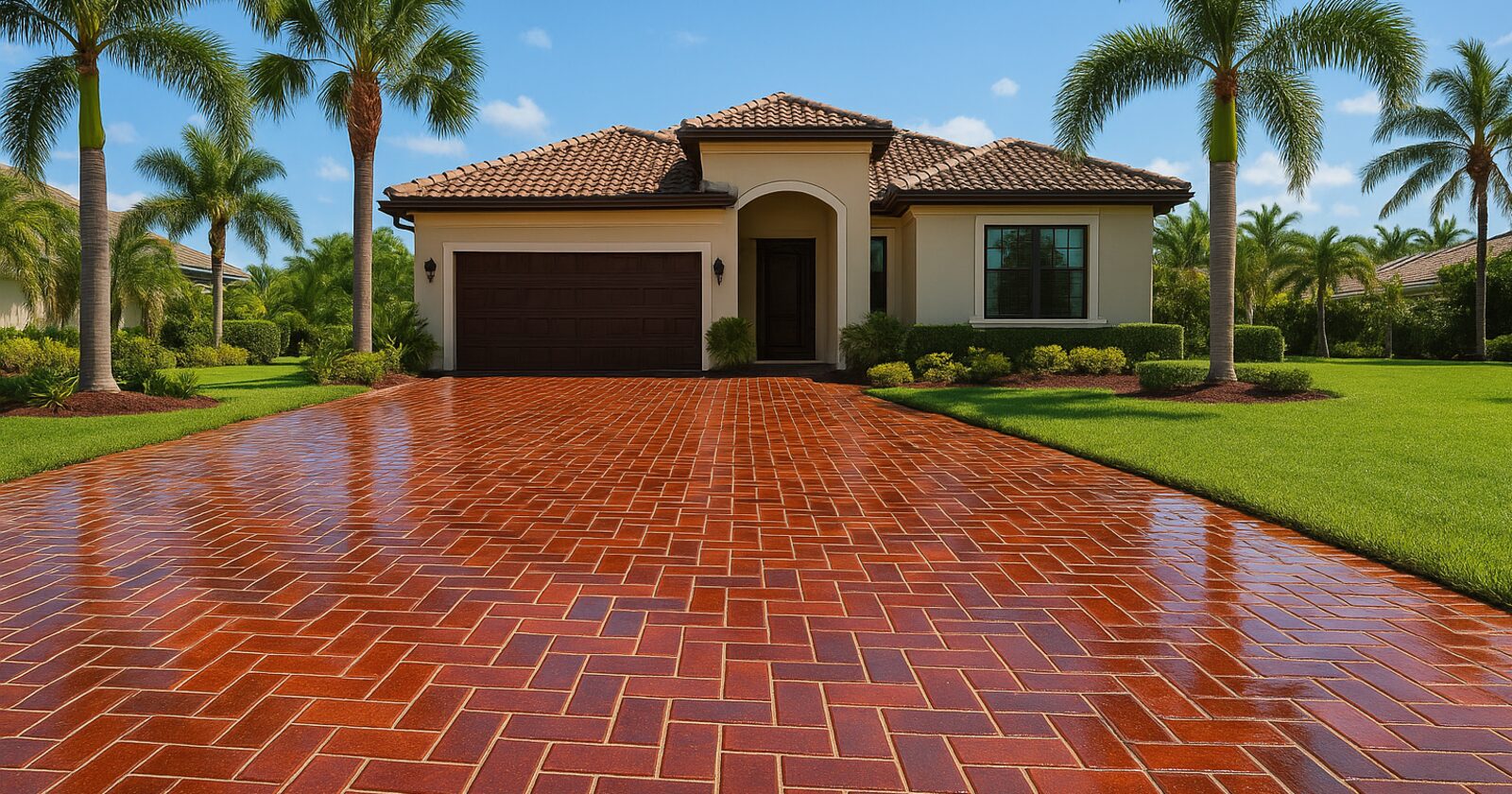
A paver driveway is the first thing anyone sees, and in our climate it takes a beating. Sun bleaches the color, summer rain drives sand out of the joints, and mold, algae, and tire marks settle into the surface. We deep-clean the pavers, re-sand the joints with polymeric sand, and apply a professional-grade sealer that restores the color and shields the driveway from UV, water, oil, and weeds. You get a driveway that looks new again and stays that way through the next few Florida summers.
Your paver driveway is the single hardest-working paved surface on your property, and here on the Gulf coast it takes more abuse than any other paver area you own. We are Gulf Coast Paver Sealing, and driveway sealing is one of the services we perform most often across Sarasota and Manatee County - because a driveway is exactly where our climate, your vehicles, and time all gang up on pavers at once. A patio sits in partial shade and only holds foot traffic. A pool deck stays wet but rarely sees a car. A driveway gets full Florida sun, the full weight of vehicles rolling over it every single day, and every drop of rain that runs off your roof and across the field. That combination is why driveways fade first, shed joint sand first, and grow weeds first, and it is why a properly cleaned, re-sanded, and sealed driveway makes such a dramatic difference the moment we finish.
Why driveways take the worst beating here
Start with the sun. A driveway is almost always the most exposed hardscape on a Sarasota or Manatee County property, with no tree canopy, no screen enclosure, and no shade structure over it. Our subtropical UV is relentless most of the year, and unsealed concrete pavers slowly bleach out under it. The warm reds go chalky, the charcoals turn gray, and the whole surface takes on a washed-out, tired look. Homeowners often tell us their driveway looks a decade older than the pavers actually are, and sun fade is usually the reason.
Then add the vehicles. Every time you pull in and turn your wheels, tires scuff and grind against the paver surface, leaving dark tire marks and slowly abrading the top layer. Hot tires on a summer afternoon can pull up loose material and leave rubber behind. The constant point-loading and turning also works joint sand loose far faster than foot traffic ever would. Cars are heavy, they move, and they do it on the same square footage day after day.
Vehicles bring stains, too. Driveways are where oil drips, where a leaking transmission leaves a dark shadow, where brake dust settles, and where an old bike, a grill, a trailer jack, or a piece of patio furniture can leave a rust ring that seems to appear overnight in our humidity. Unsealed pavers are porous, so all of that soaks straight in and sets. What could have been wiped away on a sealed surface becomes a permanent-looking blemish on a bare one.
Now factor in our rain. Southwest Florida gets intense downpours, especially through the summer storm season, and a driveway is a wide, open field of pavers that catches all of it. Every hard rain sends sheets of water washing across the surface and down the joints, and on an unsealed driveway that water carries the joint sand away with it. You have probably seen the result - a little fan of sand at the bottom of the driveway apron after a storm, and joints that sit lower and emptier every year.
Those emptying joints are an open invitation. Once the sand drops below the surface, weed seeds and wind-blown soil settle into the gap, and our climate lets them sprout almost year-round. Ants love those open joints even more - they excavate the loose sand to build their nests, pushing little volcanoes of sand up between the pavers and hollowing out the base of support underneath. Left alone, that is how a driveway starts to develop the low spots, wobbly pavers, and green fuzzy lines that make an otherwise nice home look neglected.
None of this means your pavers are failing. It means they are unprotected. Sealing is the step that was either never done or has long since worn off, and putting it back is what stops the whole cycle.
What our driveway sealing service includes
We treat driveway sealing as a full restoration, not just a coat of product sprayed over whatever is there. Sealer locks in the condition of the surface underneath it, so everything we do before we seal matters just as much as the sealer itself. Here is how we work.
First, we assess. We walk your driveway with you and look at what is actually going on - how faded the pavers are, how low the joints have dropped, what stains are present, whether there is any settling or loose pavers that should be addressed, and whether the surface has ever been sealed before. Old, failing sealer changes the plan, because it usually has to be dealt with before a fresh coat will bond correctly. This assessment is also where we confirm the finish you want and give you a firm, written quote before any work begins.
Second, we deep clean. We use a low-pressure cleaning process built for pavers, not the aggressive high-pressure blasting that chews up the paver surface and blows out whatever joint sand is left. Our approach lifts embedded dirt, algae, mildew, and the general gray film that our humidity leaves behind, and it does it without scarring the pavers. On a driveway, this stage does a lot of heavy lifting because there is simply more grime, more tire residue, and more organic growth than on a covered surface.
Third, we treat stains. Once the general grime is gone, the specific problem spots show themselves clearly, and we target them individually. Oil and grease, rust rings, and the dark tannin stains that drip from oak leaves and other landscaping each respond to different treatment, and we address them before sealing so we are not locking a stain in under the finish. We are honest here - some deep, old stains that have sat in bare pavers for years will lighten significantly but may not vanish completely. We will tell you what to realistically expect before we start rather than after.
Fourth, we re-sand the joints. This is the step that separates a driveway that stays put from one that keeps shedding sand, and it is the step cut-rate operators love to skip. We fill the joints back up with the correct sand for the job, worked down into the full depth of the joint across the entire field, not just dusted over the top. Properly filled joints restore the interlock that lets a paver driveway carry vehicle weight the way it was engineered to. Empty joints let pavers shift; full joints hold them in a tight, stable field.
Fifth, we seal. With a clean, dry, freshly sanded surface, we apply the correct sealer for a driveway in the right number of coats for the product and the condition of your pavers. Driveway sealing is not the place for a thin single pass - vehicle traffic and sun demand a proper build of protection. We apply it evenly, we watch our coverage, and we make sure the joints get locked along with the paver faces.
Choosing your finish - natural or wet-look
One of the first decisions we will talk through is finish. Paver sealers generally land in two families. A natural or matte finish protects the pavers and deepens their color a little without adding shine, so the driveway still reads as natural stone or concrete paver, just cleaner and richer. A wet-look or gloss finish adds noticeable sheen and makes the colors pop as if the pavers were freshly rained on, which many people love for the richness it brings out.
For driveways specifically, most of our Sarasota and Manatee County homeowners lean toward the natural or a low-sheen finish rather than a high gloss. There are practical reasons for that. A big field of high-gloss pavers under full Florida sun can throw a lot of glare, and a very glossy surface can feel slick underfoot, which matters more on a driveway you walk across to the mailbox or unload groceries on than it does on a shaded patio. Natural and satin finishes give you the color restoration and the full protective benefit while keeping the surface looking like a driveway and staying comfortable to use. That said, it is your home and your taste - if you want the wet look and love it, we will tell you honestly how it will behave on your particular driveway and, if it fits, we will deliver it beautifully.
How sealing stops the sand loss and the weeds
Here is the part that surprises people most. When we re-sand the joints and then seal, the sealer soaks into the top of that joint sand and binds it into a firm, stabilized surface. It is often called joint stabilization, and it changes how the whole driveway behaves. Instead of loose grains that wash away in the next downpour or blow out under a turning tire, you get joints that hold together as a unit.
That single change solves several problems at once. Your driveway stops shedding sand, so you are not sweeping up that fan of grit after every storm and the joints stay full for years instead of dropping again in months. Weeds lose their seedbed, because there is no longer a loose, open pocket of sand and grit for seeds to root into. Ants lose their easy digging, because the stabilized joints are far harder to excavate than loose sand. And because the pavers stay locked in a tight, full field, the surface stays flatter and more stable underfoot and under your tires. You are not just making the driveway look better - you are protecting the structure of it.
Stain resistance and color restoration
A sealed driveway is a driveway that fights back. Because the sealer closes off the pores at the surface, spills and drips sit on top long enough to be cleaned up instead of soaking straight in. That is the difference between wiping away an oil drop and living with a permanent dark blotch. Sealing meaningfully improves resistance to the exact stains driveways face here - automotive oil and grease, rust from metal objects and irrigation water, and the tannin staining that leaches out of oak leaves and mulch. It is not a force field, and we always tell homeowners that cleaning up spills promptly still matters, but the day-to-day defense is dramatically better than bare pavers.
Sealing also brings faded pavers back to life. After a deep cleaning strips off the gray, the sealer re-saturates the color and restores much of the depth that the sun bleached away. Those washed-out reds warm back up, the charcoals darken again, and the whole driveway looks years younger. It is one of the most satisfying parts of the job, because the transformation is visible the moment the sealer goes down. We are honest that sealing enhances and restores the color the pavers still have - it cannot repaint a paver that has physically worn away - but on the vast majority of driveways the improvement is striking.
How long it lasts in our climate, and how we time it
We will always give you a straight answer about longevity, because our Gulf coast conditions are harder on sealer than most of the country. Between the intense UV, the summer heat, the heavy seasonal rain, and the constant vehicle traffic, a driveway is the shortest-cycle paver surface there is. As a general rule here, plan to reseal a driveway roughly every two to three years to keep it fully protected and looking its best. A shaded patio might stretch longer, but a wide-open driveway under Florida sun works its sealer hard.
We help you time it rather than letting the driveway slide back to bare. When we finish, we will tell you roughly when to expect the next service based on your specific exposure and finish, and we are happy to check back in. The goal is to reseal while the previous coat is still doing its job, which keeps the process simpler, keeps the joints from emptying out again, and protects the pavers continuously instead of letting them weather bare for a year or two between coats.
What to expect on job day and cure time
We work efficiently and we keep the site clean, but a driveway does take the surface out of service for a bit, so it helps to plan ahead. On job day, you will want your vehicles off the driveway and parked elsewhere before we arrive, because the surface has to be fully clear for cleaning, re-sanding, and sealing. Depending on the size and condition of the driveway, the cleaning and stain treatment, the re-sanding, and the sealing generally flow across the day, with drying time built in between the cleaning and the seal so we are never sealing over damp pavers.
Cure time is the part to plan around most. After we seal, the driveway needs time before it can take weight again. As a general guideline in our climate, plan to keep foot traffic off for several hours and to keep vehicles off for a longer window - commonly around one to two days before you drive and park on it again, depending on the product, the coats, the temperature, and the humidity that day. We will give you the exact timeline for your job before we leave, along with simple guidance on what to avoid while it cures. Following that window is what lets the sealer harden into the tough, protective finish you are paying for, so it is worth arranging a day or two of parking elsewhere.
Our honest, firm-quote approach
We price driveway sealing with a firm, written quote after we have actually looked at your driveway, and we stand behind that number. We would rather spend a few minutes assessing the real condition of your pavers - the fade, the joints, the stains, and any prior sealer - than throw out a cheap phone estimate that balloons once we show up. When we hand you the quote, it reflects the full service: the deep low-pressure cleaning, the stain treatment, the complete joint re-sanding with the correct sand, and the right sealer applied in the right number of coats for a driveway. No vague ranges, no surprise add-ons at the end, and no upsell pressure.
We are a local Sarasota and Manatee County company, and driveways are a big part of what we do here because they are the surface that needs us most. If your paver driveway has faded in the sun, if the joints are washing out and sprouting weeds, or if you just want to protect a good driveway before our climate gets to it, we would be glad to come take a look, tell you honestly what it needs, and give you a firm quote to bring it back and keep it that way.
Get started
Request a free quote
Tell us what you need. No pressure, and a real person gets right back to you.