
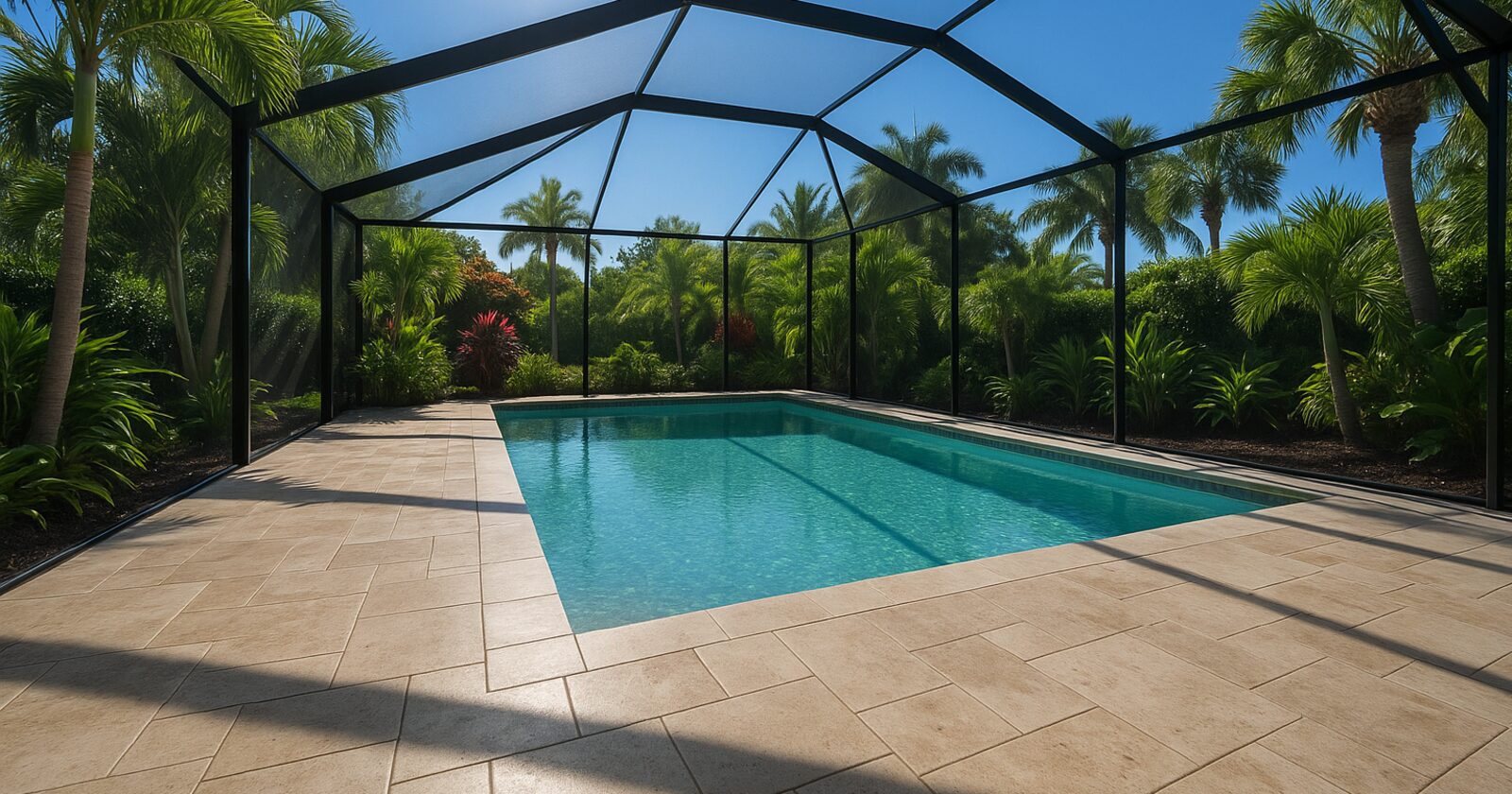
Pool decks and screened lanais are where pavers fail fastest here. Constant splash-out, chlorine, humidity, and shade grow algae and mildew in the joints, and the surface can turn slick and dingy. We clean the deck down to fresh paver, re-sand the joints, and apply a sealer rated for wet, high-traffic areas so the color pops, the surface sheds water, and algae has nothing to grip. We can use a matte or a low-sheen finish that stays comfortable underfoot and won't turn your deck into a mirror in the sun.
Pool Deck Sealing in Sarasota and Manatee County
A pool deck is the hardest-working paved surface on your property, and here on the Gulf coast it takes more abuse than almost anywhere else in the country. We seal paver and travertine pool decks and lanais across Sarasota and Manatee County, and we approach them differently than a driveway or a front walk, because a pool deck has to solve two problems at once. It has to look clean and finished, and it has to stay safe under wet, bare feet. Those two goals can pull against each other if the work is done carelessly, so the way we clean, sand, and seal a pool deck is built around getting both right.
Why pool decks are so demanding here
Think about what your deck lives through in a single afternoon. Swimmers climb out and drip a constant sheet of water across the coping and the first few feet of deck. Splash-out from the pool keeps whole sections damp for hours. Rain arrives most summer afternoons and pools in the low spots. If you have a screen cage, and most homes in Bradenton, Lakewood Ranch, Palmetto, Venice, and Sarasota do, that cage throws shade and holds humidity in, so parts of the deck almost never fully dry out. Add our long warm season and you have created the exact conditions that algae, mold, and mildew love. They do not need much: shade, moisture, and a porous surface to grip. An unsealed or under-maintained pool deck gives them all three.
On top of the biological pressure, a pool deck absorbs things a driveway never sees. Sunscreen and tanning oils drip and soak in and leave dark shadows. Salt rides in on the air off the Gulf and, on saltwater pools, splashes directly onto the stone. Suntan lotion, leaf tannins from oaks and palms, fertilizer overspray from the lawn, and the fine gray-green film of algae all work into open pores. Left alone, the surface goes dull, gets slick in the shaded zones, and starts to look tired years before it should. Sealing is how you get ahead of all of it.
The finish decision, and why we favor matte
This is the single most important choice on a pool deck, and it is where we push back on a common request. A lot of homeowners come to us wanting a wet, glossy, high-sheen look because it makes the color pop and it photographs beautifully. On a pool deck, we generally steer away from a slick high-gloss finish, and we will tell you why plainly. A heavy gloss sealer can leave the surface slippery when it is wet, and a pool deck is wet constantly. Around a body of water, with kids and older family members walking on it barefoot, slip resistance is not a small detail. It is the whole point.
So on pool decks and lanais we favor a matte or low-sheen finish, and where it makes sense a penetrating sealer that soaks into the stone rather than building a film on top. You still get protection, you still get richer, cleaner color, and you keep the natural texture and grip of the surface underfoot. If you want a little more richness we can use a low-sheen product that adds a soft, satiny warmth without turning the deck into an ice rink. When a client really wants more shine, we talk through where the water actually lands and we can add slip-resistant additives to the sealer to keep traction up. The guiding rule stays the same: safety first around the pool, good looks right behind it. We would rather have a slightly more understated deck that nobody slips on than a mirror finish that becomes a hazard the moment someone climbs out of the water.
What the service includes, step by step
Every pool deck we seal starts with an assessment. We look at the surface material, because a paver deck and a travertine deck are not treated the same way. We check for cracked or sunken pavers, for coping that has come loose, for low spots that hold water, and for how much algae and mold has taken hold and where. The shaded corners under the cage almost always tell a different story than the sunny center of the deck. That walk-through tells us how gentle we need to be and what the deck needs before any sealer goes down.
Then we clean, and this is where a pool deck demands restraint. We use a gentle, low-pressure cleaning process that is safe for travertine and softer pavers. Travertine especially can be pitted, etched, and permanently scarred by an aggressive pressure washer in the wrong hands, and once you blast the surface open you cannot put it back. We clean with the right combination of controlled pressure and the correct cleaning solutions so the deck comes back to a true, even color without tearing up the stone.
We treat algae and mold at the root, not just at the surface. Blasting the green off with water makes a deck look clean for a week, but if the spores are still alive in the pores they come right back, faster each time. We apply treatments that kill the growth down in the material so the deck stays clean longer and so the sealer we put down later is bonding to a genuinely clean surface instead of trapping living organisms underneath it.
Next comes joint re-sanding on paver decks. Over time the sand between your pavers washes out, and on a pool deck it does not just disappear into the yard, it washes straight into the pool, where it ends up in your filter, your pump basket, and on the floor of the pool you then have to vacuum. We refill the joints with the proper sand so the pavers stay locked together, the surface stays stable underfoot, and less grit ends up in the water. Stable joints also mean fewer wobbling pavers and fewer trip points around the deck.
Finally we seal with the right product for your surface: a penetrating sealer or a low-sheen sealer chosen for a pool environment, applied to properly cleaned and dried stone. Timing matters here, because sealing a deck that is still holding moisture underneath can cloud the finish. We work with the weather and the drying conditions so the sealer goes down onto a surface that is ready for it.
How sealing actually protects a pool deck
Sealing works by closing up the open pores in the paver or travertine. Those pores are exactly what algae, mold, sunscreen, and salt use to get a grip. When they are sealed, water and organic growth sit on top of the surface instead of soaking in, which means the deck sheds dirt more easily, resists staining, and is far quicker to rinse or wipe clean. That same closed surface slows algae and mold regrowth, because the spores no longer have the porous, damp footholds they need to establish. It does not make a deck immune, nothing does in this climate, but it buys you a much longer stretch of clean surface between deep cleanings.
Sealing also helps hold the joint sand in place. A stabilizing sealer binds the top layer of joint sand so it resists washing out in the rain and splash-out, which keeps more of it out of your pool. Fewer refills, a more stable deck, cleaner water.
Heat, comfort, and protecting travertine
Comfort underfoot is a real Florida consideration. A big reason people choose travertine and lighter pavers around a pool is that they stay cooler than dark concrete in our sun. We keep that in mind when we recommend a finish. A penetrating or low-sheen sealer keeps the natural, cooler feel of the stone, where a heavy film-building gloss can change how the surface holds heat and how it feels on bare feet. Travertine in particular deserves care: it is a beautiful, naturally porous stone that can stain and etch, and it needs a sealer suited to it and a cleaning process that respects how soft it can be. Done right, sealing protects travertine from the salt, sunscreen, and organic staining that would otherwise work into it, while keeping the light, cool, natural look that made you choose it.
How often to reseal, and the splash-zone reality
In our climate we generally recommend resealing a pool deck every two to three years. The sun, the constant moisture, and the daily use wear a sealer faster here than the label lifespan you might read for a drier part of the country. And the deck does not wear evenly. The splash zones right around the coping and the spots that stay damp under the cage break down first, because they take the most water and the most foot traffic. The sunny middle of the deck can still look fine while the edges near the water are ready for attention. When we come back out we can focus on where the wear actually is rather than blindly redoing everything.
Job day and getting back in the water
On the day of the job, we will let you know how long the deck needs to stay clear and how long the sealer needs to cure before it is back to full use, including before you are back in and out of the water. Cure time depends on the product, the temperature, and the humidity that day, so we give you a real timeline for your specific job rather than a one-size answer. Plan on keeping the deck dry and free of foot traffic during the cleaning and drying stages and through the initial cure. We would rather you wait a little longer for a finish that lasts than rush back on and mar fresh sealer.
Our honest, firm-written-quote approach
We quote pool decks the same way we quote everything: we come look at your actual deck, in person, and give you a clear, firm written price for the work described. No vague ranges that balloon on the day of the job, no surprise add-ons once the crew arrives. If your deck needs repairs before sealing, loose coping, sunken pavers, a low spot that ponds, we will point it out honestly and tell you what it means, and you decide. Our goal is a pool deck that is clean, protected, and safe underfoot for your family, and a number you can trust before we ever start.
If you are in Sarasota or Manatee County and your pool deck is looking green in the shady corners, feeling slick after a swim, or shedding sand into the pool, we would be glad to take a look and give you a straight answer about what it needs.
Get started
Request a free quote
Tell us what you need. No pressure, and a real person gets right back to you.