
Parrish pavers vs. Sarasota pavers: does distance from the coast actually change how fast they degrade?
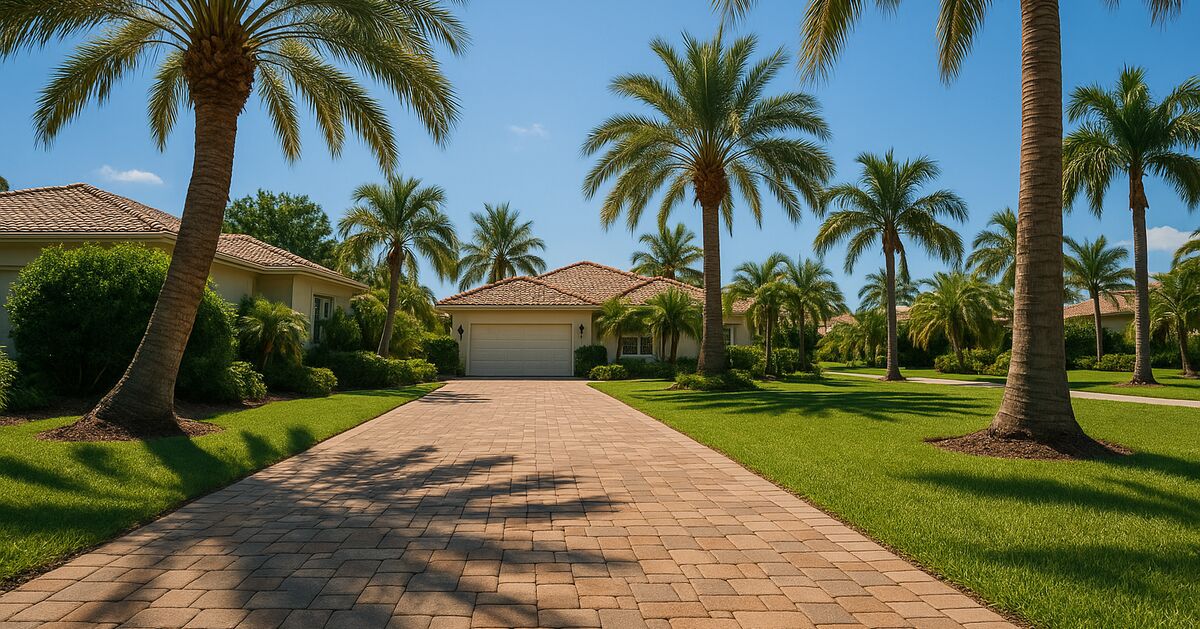
Parrish homeowners sometimes hear that coastal properties get the worst of it when it comes to paver wear, and they assume their inland location gives them a free pass. It does not, quite. The truth is more interesting: distance from the Gulf of Mexico changes the type of stress your pavers face more than it eliminates stress altogether. Understanding those differences helps you time maintenance correctly and avoid surprises no matter where you live on the Gulf Coast.
What "coastal degradation" actually means
When people talk about coastal pavers wearing out faster, they are usually pointing to a handful of specific mechanisms: salt aerosol, higher ambient humidity, sand-laden wind, and intense UV exposure from light bouncing off water. All of those are real forces. Salt concentrations in coastal air tend to drop off with distance from the shoreline, generally reaching much lower levels within a few miles of the water. Properties right on Siesta Key or the Venice beachfront receive meaningful salt aerosol exposure. A home in Sarasota's Palmer Ranch neighborhood, just a few miles from tidal water, receives considerably less. A home in Parrish, sitting roughly 25 to 30 miles northeast of the Gulf, receives very little measurable salt aerosol under normal conditions.
So yes, distance matters for salt. But salt is only one item on a longer list.
The Sarasota and coastal-corridor picture
For homeowners in Sarasota, Nokomis, Venice, and areas of Palmer Ranch that back up to tidal water or the Intracoastal, the stressors stack up in a particular way.
Salt aerosol and chloride intrusion. Salt is a hygroscopic compound, meaning it actively draws moisture out of the air and holds it against whatever surface it has settled on. When salt settles into the joint sand between pavers and into the paver surface itself, it traps moisture and accelerates the breakdown of calcium carbonate binders in concrete pavers and travertine alike. Over time this shows up as surface pitting, spalling, and accelerated joint sand loss. Our post on why travertine pavers pit, flake, and powder covers that mechanism in detail.
UV intensity near open water. The Gulf of Mexico and the many interconnected bays and bayous around Sarasota and Venice act as giant reflectors. Pavers on west-facing driveways and pool decks near open water receive both direct UV and reflected UV. UV degrades unsealed paver pigment and, critically, also degrades sealer itself. A sealer that might last three to four years in a shaded inland setting can show chalking, peeling, or cloudiness in half that time on a sun-hammered coastal deck. Our piece on when old sealer clouds, peels, or traps moisture explains why a compromised sealer coat is not just cosmetic.
Tidal humidity cycles. Areas close to open water experience humidity that swings dramatically through the day. Morning fog and high relative humidity followed by intense midday sun is a cycle that drives repeated expansion and contraction in both the paver material and the joint sand. Over years, that cycling loosens polymeric sand and opens hairline cracks where water, mold spores, and roots can enter.
Biological growth. Surfaces near water bodies often stay damp longer, which can encourage faster algae and mold growth. You can read the detailed reasoning in our post on why lake-view pavers grow algae faster. The short version: spore counts are higher near water, surfaces stay damp longer, and organic debris from nearby vegetation feeds colonies once they establish.
The Parrish and inland picture
Parrish, and to some degree the northern reaches of Lakewood Ranch and Bradenton that push toward Manatee County's interior, sit well away from tidal influence. Salt aerosol is not a meaningful concern. Does that mean pavers degrade slowly? Not exactly.
Heat accumulation without sea breeze relief. This is the factor that surprises inland homeowners. Coastal communities benefit from the Gulf's sea breeze effect, which typically kicks in during the afternoon and can drop surface temperatures by several degrees. Parrish, farther inland, experiences a more intense heat dome effect during summer months. Paver surface temperatures on a west-facing driveway in Parrish in July can reach 140 to 160 degrees Fahrenheit, which is consistent with measurements NREL has recorded for dark horizontal surfaces under Florida sun conditions. At those temperatures, unsealed pavers lose joint sand faster through thermal expansion and contraction, and any existing sealer that was not rated for high surface temperatures will degrade prematurely.
Heavy clay soils and ground movement. Much of Parrish and surrounding Manatee County inland areas sit on soils with a higher clay content than the sandy coastal soils closer to the Gulf. Clay soils shrink and swell significantly with wet and dry cycles. Florida's wet season (roughly June through September, per NOAA climate data) saturates these soils, and the dry season contracts them. That movement translates directly into paver shifting and settling. Pavers over clay-heavy base material need periodic re-leveling and re-sanding more often than those over stable coastal sand. The joint sand that protects pavers from lateral movement gets disrupted repeatedly, leaving gaps that admit weeds, water, and ants.
Afternoon thunderstorm intensity. Inland Southwest Florida is among the most lightning-active regions in the country, per NOAA's storm data summaries, but more relevant to pavers is the rainfall intensity. Afternoon convective storms in summer can drop heavy rainfall in a short period, sometimes over an inch within an hour. That hydraulic force, focused on a driveway or patio with open joints, physically displaces joint sand at a rate that surprises homeowners. Coastal areas receive the same storms, but wind-driven salt combined with rain creates a slightly different erosion chemistry.
Organic debris and shade. Parrish properties tend to have younger landscaping (many neighborhoods are relatively new developments) or properties with large established oaks and pine trees. Oak tannins and pine sap are both mildly acidic, and tannin staining on pavers is a common complaint among inland homeowners. Shaded pavers also stay damp longer after rain, which accelerates mold growth even without any tidal influence.
Comparing the two side by side
So how do Parrish pavers and Sarasota pavers actually stack up in terms of degradation?
- Salt-related pitting and spalling: Clearly worse closer to the coast. Parrish pavers have a real advantage here.
- UV-related sealer failure: Roughly comparable. Both areas receive intense Florida sun, though reflective light amplification is greater near open water.
- Joint sand erosion from rain: Inland areas may actually see faster joint sand loss from hydraulic force due to soil instability and storm intensity.
- Biological growth (mold, algae, moss): Coastal areas tend to see faster colonization, but shaded inland pavers can catch up quickly, especially on north-facing surfaces.
- Paver shifting and settling: Inland clay-heavy soils create more ground movement, which means more re-leveling needs over time.
- Efflorescence: Both areas see efflorescence (the white salt bloom that rises from within concrete pavers), but coastal pavers that trap chloride ions can experience a more aggressive version. Our FAQ covers efflorescence and white haze after sealing if you've already noticed it.
The net takeaway: coastal pavers (Sarasota, Venice, Nokomis, coastal Bradenton) tend to degrade from the outside in, driven by salt, UV reflection, and salt-amplified moisture retention. Inland pavers (Parrish, northern Lakewood Ranch, interior Bradenton) tend to degrade from the bottom up, driven by soil movement, hydraulic sand erosion, and heat accumulation. Both patterns are real, and both respond well to proper sealing, re-sanding, and periodic restoration. They just respond to slightly different protocols.
What this means for maintenance timing
Coastal homeowners in areas like Sarasota, Venice, and Nokomis should plan for more frequent sealer inspection, roughly every 18 to 24 months, even if the sealer was rated for three years. Check for cloudiness, peeling edges, and any spots where the sealer appears to be trapping moisture beneath it. Salt-laden environments are harder on sealer than the product label typically accounts for.
Inland homeowners in Parrish and surrounding Manatee County areas should focus particular attention on joint sand condition after every wet season. If you notice ants building mounds in the joints, weeds establishing themselves, or individual pavers beginning to rock underfoot, those are all signs that the joint sand has been compromised and needs to be replaced before re-sealing. Sealing over depleted joint sand is a common mistake because the sealer then bonds paver edges together without the sand support underneath, which causes cracking when the ground moves.
Both inland and coastal homeowners benefit from understanding how Gulf Coast heat and humidity affect paver sealer cure time, especially if they're planning a sealing project during the summer months. The cure window matters whether you're in Parrish or on the Sarasota bayfront.
The role of paver material and original installation
One variable that cuts across geography is the paver material itself. Concrete pavers, the most common choice in newer neighborhoods throughout Parrish, Lakewood Ranch, and Wellen Park, are more vulnerable to salt chloride than brick or natural stone but also respond well to penetrating sealers that block chloride entry. Natural travertine, popular around pool decks throughout Sarasota and Palmer Ranch, is more porous and requires a different sealer chemistry than concrete. A penetrating sealer appropriate for travertine near the coast, for example, focuses on moisture exclusion and resists the hygroscopic salt effect without trapping vapor inside the stone.
The base installation quality also matters enormously. A properly compacted base with appropriate bedding sand depth performs far better in clay-heavy inland soils than a shallowly installed base, regardless of how good the sealer is on top. If your Parrish paver sealing and restoration project uncovers widespread settling, the right fix addresses the base, not just the surface.
What to do next
If you're unsure whether your pavers are showing coastal-type degradation or inland-type degradation, a professional assessment is the most efficient starting point. Our paver sealing and restoration services cover the full range of conditions described here, from salt-eroded coastal pavers to thermally stressed and sand-depleted inland installations. We work across the entire Gulf Coast corridor, from Parrish and Bradenton in the north down through Sarasota, Palmer Ranch, Nokomis, and Venice in the south.
The right question isn't simply "how far am I from the coast?" It's "what specific stressors is my installation facing, and what's the current condition of the sealer, joint sand, and base?" Those answers determine the right maintenance path, and they're different for nearly every property we see across the Gulf Coast.
Browse the full blog for more location-specific guidance, or get in touch to schedule a free assessment of your pavers' current condition.
Sources & further reading
- Ambient Air Quality and Coastal Pollutants (U.S. Environmental Protection Agency)
- NOAA Lightning Activity and Storm Frequency Data (NOAA National Weather Service)
- National Renewable Energy Laboratory (named in this article) (National Renewable Energy Laboratory)
- National Oceanic and Atmospheric Administration (named in this article) (National Oceanic and Atmospheric Administration)
Claim-by-claim audit (3 checked)
- “Salt concentrations in coastal air tend to drop off with distance from the shoreline, generally reaching much lower levels within a few miles of the water.” (rewritten to what the article can stand behind)
- “Afternoon convective storms in summer can drop heavy rainfall in a short period, sometimes over an inch within an hour.” (rewritten to what the article can stand behind)
- “Surfaces near water bodies often stay damp longer, which can encourage faster algae and mold growth.” (rewritten to what the article can stand behind)
Get started
Request a free quote
Tell us what you need. No pressure, and a real person gets right back to you.