
Why are my pavers turning white after sealing? Efflorescence and haze explained
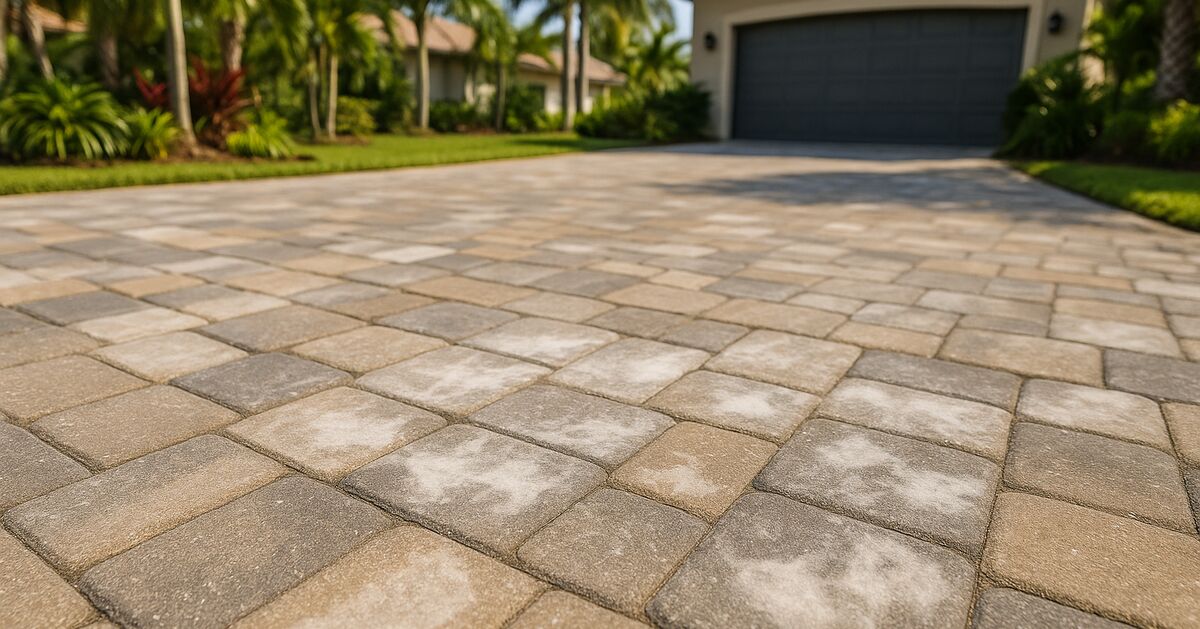
You just had your driveway or pool deck sealed, and now there's a milky white film sitting on top of the pavers. It looks worse than before the work was done, and you're wondering what went wrong. You're not alone - this is one of the most common calls we get from homeowners across Lakewood Ranch, Venice, Sarasota, and Bradenton, and it has a clear explanation.
There are actually two distinct things that make pavers turn white after sealing, and they have very different causes and fixes. One is efflorescence, a natural mineral migration from inside the paver itself. The other is sealer haze (sometimes called blushing), a curing problem caused by moisture getting trapped under or inside the sealer film. Understanding which one you're looking at is the first step toward fixing it - and preventing it from coming back.
What Is Efflorescence, and Why Does It Happen to Florida Pavers?
Efflorescence is not a coating failure. It is not damage. It is a completely natural process that occurs in any concrete-based product - including the vast majority of paver systems sold in Southwest Florida neighborhoods.
Here is how it works: concrete pavers are made with Portland cement, aggregates, and water. When water moves through the body of the paver - whether from rain, irrigation, or ground moisture - it dissolves soluble calcium salts inside the material. As that water migrates toward the surface and evaporates, it leaves those salts behind as a white or grayish crystalline deposit. The result is an uneven white film that looks almost powdery or chalky.
In Florida, this process is accelerated by several factors:
- High humidity and frequent rain cycles. The Gulf Coast gets drenched every afternoon from June through September. Water is constantly moving in and out of paver systems.
- Irrigation systems. Many homes in communities like Lakewood Ranch and Wellen Park run sprinklers on tight cycles, and overspray onto driveways and pool decks keeps the substrate perpetually damp.
- New pavers. Fresh pavers have the highest concentration of free calcium hydroxide inside them. This is why efflorescence is almost always most dramatic in the first one to two years after installation. If you are curious about timing for new installations, our post on sealing brand-new pavers and how long to wait in Florida covers this in detail.
- Sandy, porous soils. Much of the soil across Sarasota, Nokomis, and Venice drains rapidly, which means groundwater moves freely and keeps cycling through paver bases.
The tricky part is that sealing can actually trigger a more visible efflorescence event. When you apply a film-forming sealer, you essentially cap the surface. Any salts that were migrating upward get pushed back and concentrate. The next rain or humidity event can force them upward in large amounts, and now they have nowhere to go except directly under the sealer film, where they become very visible as a white haze trapped beneath the coating.
What Is Sealer Haze (Blushing), and How Is It Different?
Sealer haze is a different problem, though it looks nearly identical. Instead of mineral salts coming from inside the paver, haze is caused by moisture interfering with the sealer itself during application or curing.
Solvent-based and water-based sealers both need to go down on a dry surface and cure in the right conditions. If either of these conditions is not met, the sealer film turns milky or cloudy. The most common causes here in Southwest Florida include:
- Sealing over damp pavers. Our afternoon thunderstorms are unpredictable, and morning dew can linger well into mid-morning in the cooler months. Pavers that look dry on top may still be holding moisture a centimeter down. We have a deeper guide on pressure washing and drying pavers before sealing in Florida that explains why surface prep is so critical.
- High ambient humidity during application. On a typical summer afternoon in Bradenton or Palmer Ranch, relative humidity can sit at 85 to 95 percent. Water-based sealers in particular are sensitive to high humidity because the evaporation of the carrier is slowed dramatically. The solids in the sealer can begin to coalesce unevenly, trapping micro-droplets of moisture in the film.
- Applying sealer too thick. A thick coat traps more moisture and takes far longer to cure. Two thin, even coats almost always outperform one heavy coat.
- Recoating too soon. If a second coat is applied before the first has properly dried, you seal moisture between the layers. The result is a persistent white haze that will not clear on its own.
- Temperature swings. In Parrish and inland areas, temperatures can dip quickly in winter mornings. If a sealer applied in the afternoon drops below the minimum cure temperature overnight, the film does not form properly.
How to Tell Efflorescence from Sealer Haze
Both look like a white film, but there are a few ways to distinguish them:
- Rub it. Efflorescence that is sitting on top of a sealer will often leave a faint powder on your fingertip. True sealer haze is smooth and glassy to the touch.
- Water test. Pour a small amount of water on the affected area. If the white appearance temporarily disappears when the area is wet and returns as it dries, you are almost certainly looking at efflorescence salts. Sealer haze stays consistently cloudy whether wet or dry.
- Timeline. If the white appearance showed up within the first few days after sealing and the weather was humid or rainy, sealer haze is the more likely culprit. If it appeared gradually over weeks or months and is patchy and powdery, efflorescence is the more likely cause.
- Location. Sealer haze tends to be uniform across the entire sealed surface. Efflorescence often appears in patterns - along grout lines, in lower spots where water pools, or in areas that receive irrigation overspray.
Can You Fix Pavers That Have Already Turned White?
Yes, in most cases both problems are fully correctable. The approach depends on which problem you have.
Fixing Efflorescence
Light efflorescence that is sitting on top of an intact sealer film can sometimes be removed with a diluted efflorescence cleaner (an acidic solution), followed by a thorough rinse. However, if the deposits are trapped beneath the sealer film, the sealer typically needs to be stripped first, the efflorescence treated, and then the surface resealed properly.
Stripping sealer is not a small job. It requires a chemical stripper appropriate for the sealer type (solvent-based or water-based), mechanical agitation, and thorough removal before any new product is applied. Skipping this step and applying new sealer over existing hazy or contaminated sealer just buries the problem.
For persistent or recurring efflorescence, a penetrating silane-siloxane sealer applied after the surface is clean and treated can significantly slow future salt migration, because it does not form a surface film - it fills pore spaces from the inside. Whether that approach is right for your specific paver type is worth discussing with a professional. You can also review our frequently asked questions page for more context on sealer types and what we recommend for Gulf Coast conditions.
Fixing Sealer Haze
Mild haze from a single thin coat sometimes resolves on its own as the sealer continues to cure over several days. Applying heat (even just direct Florida sun on a low-humidity day) can help drive off residual moisture. However, significant or persistent haze almost always requires stripping the cloudy sealer, allowing the pavers to dry thoroughly, and resealing under correct conditions.
The window for successful sealing in Southwest Florida is not as wide as in drier climates. For most film-forming sealers, you want:
- Paver surface temperature between roughly 50°F and 90°F
- Relative humidity below 75 to 80 percent
- No rain in the forecast for at least 24 hours after application
- Pavers that have been dry for at least 24 to 48 hours after any washing or rain event
In practice, this means early morning applications in the cooler months (November through April) give the best results here on the Gulf Coast. Summer sealing is possible but requires much more careful timing around the daily storm pattern.
Why This Problem Is So Common in Southwest Florida Specifically
Other parts of the country deal with efflorescence and sealer haze too, but our region has a particular combination of factors that makes it more likely:
- The wet season is intense and predictable. Six months of near-daily afternoon rain means moisture is constantly present.
- The paver market boomed fast. Rapid growth in communities from Wellen Park down through Venice and Nokomis means enormous numbers of paver installations that are only one to three years old - right in the peak window for efflorescence.
- DIY and low-bid sealing is common. The temptation to seal pavers yourself on a weekend or to go with the cheapest bid is understandable, but mistakes in prep or application are the single biggest cause of sealer haze in our area. A job done in the wrong conditions, or over pavers that were not fully dry, is going to show problems.
- Irrigation is almost universal. Nearly every home in Lakewood Ranch, Palmer Ranch, and similar master-planned communities has an automated irrigation system. Overspray keeps the paver base constantly cycling between wet and dry, which drives ongoing efflorescence for years if not managed.
What a Properly Done Job Looks Like
When sealing is done correctly under the right conditions, the finished surface should be clear and consistent - whether you chose a wet-look or natural finish. You should not see white patches, milky areas, or any cloudiness. The color of the pavers should look enhanced (for wet-look) or protected but natural, with no film visible in shaded areas.
A reputable contractor will check weather forecasts, test surface moisture before applying any product, and not rush the prep or the application. If anything looks questionable on the day of the job - an unexpected rain the night before, humidity that is running higher than expected - a good contractor delays rather than pushes through and hopes for the best. Our services page outlines the prep and application process we follow on every job.
When to Call a Professional
If your pavers are already showing white haze or efflorescence after a recent sealing job, the honest answer is that correcting it properly is not a beginner task. Choosing the wrong stripper, using too strong an acid cleaner, or resealing before the surface is genuinely ready can create new problems on top of the existing ones.
If you are in the Sarasota, Manatee, or Charlotte County area - including communities like Lakewood Ranch, Bradenton, Venice, Nokomis, Parrish, or Palmer Ranch - we are happy to take a look and tell you exactly what is going on. Get in touch with us and we can schedule a time to assess the pavers and walk you through the options before any work is done.
White pavers after sealing are frustrating, but they are almost never a permanent problem. With the right diagnosis and the right process, your pavers can look the way they were supposed to look when the job was finished.
Get started
Request a free quote
Tell us what you need. No pressure, and a real person gets right back to you.