
How Gulf Coast heat and humidity affect paver sealer cure time
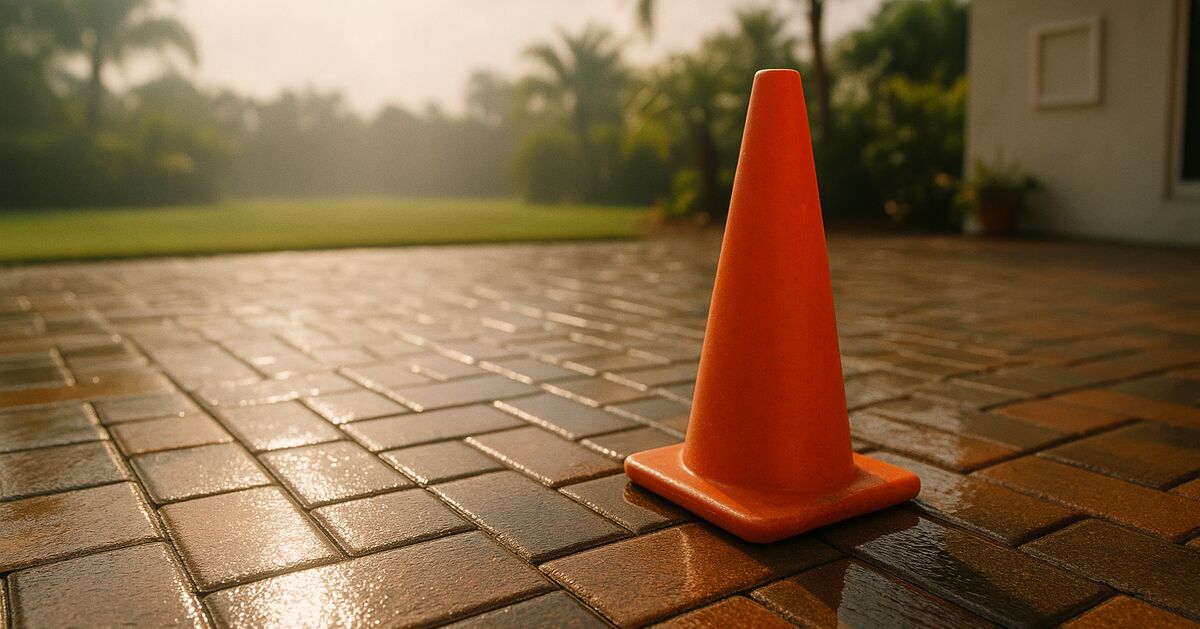
Florida sunshine feels like it should dry everything faster, but paver sealer does not work the way a fresh coat of paint on a wall does. If you walked on your newly sealed driveway in Lakewood Ranch the same afternoon it was applied because it "felt dry," there is a real chance you damaged the finish before it ever had a chance to protect anything. Understanding the difference between "dry to the touch" and "fully cured" is one of the most practically useful things a paver owner can know, and in Southwest Florida's climate, the gap between those two states is wider and more unpredictable than almost anywhere else in the country.
Dry to the touch versus fully cured: they are not the same thing
When a sealer applicator sprays or rolls product onto your pavers, the solvent or water carrier begins evaporating almost immediately. Within an hour or two in warm weather, the surface can feel dry and even slightly tacky-free. That is the "dry to the touch" stage, and it means almost nothing in terms of structural strength.
Full cure is a different process entirely. It is the point at which the sealer's polymer chains have fully cross-linked, the remaining carrier has completely off-gassed from deep within the coating, and the film has reached its designed hardness and adhesion strength. Until that happens, the sealer is still vulnerable to:
- Scuffing or tearing from foot traffic
- Tire marks and tire pull from vehicles
- Water pooling that gets trapped beneath the not-yet-sealed surface film
- Chemical contamination from fertilizer, pool water, or cleaning products
- Bubbling or cloudiness from re-wetting before the film is stable
Most sealer manufacturers list cure times on their data sheets, but those numbers assume "standard" conditions, which generally means moderate temperature and around 50 percent relative humidity. On the Gulf Coast, we almost never see those conditions, especially from May through October.
What heat actually does to curing sealer
High ambient temperature speeds up solvent evaporation from the top of the sealer film. That sounds helpful, but it creates a specific problem: the top layer can skin over and seal itself before the lower portion of the film has had a chance to off-gas properly.
Think of it like baking bread at too high a temperature. The crust forms and hardens on the outside while the inside is still raw. With sealer, a rapidly formed top skin traps residual solvent vapor underneath. That vapor has to go somewhere, and it typically pushes outward as micro-bubbles, creating the white haze or fish-eye blistering that homeowners sometimes notice after a hot-day application.
This is one of the key reasons that experienced paver sealing professionals in Sarasota, Bradenton, and Venice plan their work carefully around the time of day. The ideal application window is typically in the morning, when surface temperatures are lower and the heat of the day is still ahead of the sealer, allowing it to cure in increasing warmth rather than baking immediately under a midday sun that has already pushed paver surface temperatures above 130 degrees Fahrenheit.
Even after the application is complete and conditions look fine, a sudden spike in afternoon heat can accelerate the surface cure while the deeper layers lag behind. This is not a failure of the product. It is simply physics working against you if you are not aware of it.
What humidity does, and why it matters more than most people expect
Humidity is the bigger wild card on the Gulf Coast. Sarasota and Manatee counties regularly see relative humidity above 85 or 90 percent in summer, and the air during afternoon rain season is so saturated that moisture can settle right back onto a surface that was barely dry moments earlier.
For solvent-based sealers, high humidity slows evaporation because the air is already carrying nearly as much moisture as it can hold. The solvent wants to evaporate but the surrounding air offers little gradient to pull it away. Cure times can stretch significantly.
For water-based sealers, the dynamic is slightly different but the result is similar. The water carrier in the emulsion needs to evaporate for the polymer particles to coalesce into a continuous film. In very humid air, that evaporation is sluggish. The film formation process is delayed, meaning the sealer remains more vulnerable for a longer period.
And then there is the rain. A Gulf Coast afternoon thunderstorm can arrive in under thirty minutes with almost no visible warning. If a sealer has not yet reached even the dry-to-touch stage and a hard rain hits, you are looking at water spotting, dilution of the sealer near the surface, or outright washoff in low spots that pond water. This is not a small cosmetic issue. It can require re-application of sections, or in worse cases, stripping and starting over.
Realistic cure time expectations in Southwest Florida conditions
So what should you actually expect? Here is a practical breakdown based on typical Gulf Coast conditions, keeping in mind that specific products vary and a reputable contractor will follow the manufacturer's data sheet for whatever they apply:
Foot traffic: In dry spring conditions (March or April, lower humidity, temperatures in the mid-70s to low 80s), light foot traffic is typically safe after 4 to 6 hours. In peak summer humidity, that window stretches to 8 to 12 hours, and you should err toward the longer end.
Vehicle traffic: This is where many homeowners make costly mistakes. Even when foot traffic is safe, vehicle traffic puts dramatically more stress on the sealer film. A passenger car tire on a freshly sealed driveway can leave permanent scuff marks or actually peel sections of sealer. Most professional applicators recommend 24 hours minimum for vehicles, and 48 hours during high-humidity summer months. If you are in Parrish or Wellen Park and your sealed driveway is your only access to the garage, plan ahead.
Full cure (hardness, chemical resistance, final sheen): The sealer typically reaches its full designed properties somewhere between 72 hours and 7 days after application, depending on conditions. You might not see or feel the difference on the surface, but during this window the film is still developing its ultimate hardness. Avoid dragging furniture, using harsh cleaning products, or applying pool chemicals near the edges of a pool deck that was just sealed.
Rain exposure: A light drizzle after 12 to 24 hours is usually not catastrophic for most sealers. A hard rain within the first 2 to 4 hours can cause real damage. Any rain within the first hour of application almost always requires re-evaluation of the affected areas.
What you should avoid doing during the cure window
This is the section that saves people money. The following activities have damaged fresh sealer jobs on Gulf Coast properties, more than once:
- Driving on the driveway the same day. Even if it feels solid, tire marks from warm rubber on warm sealer are often permanent.
- Running lawn sprinklers or irrigation systems. Many Lakewood Ranch homeowners have automated irrigation that comes on at 4 a.m. If sealer was applied the previous afternoon and did not have enough cure time before dawn, the sprinklers can cause spotting or streaking.
- Letting pets walk on freshly sealed pavers. Dog paw prints and cat scratches in not-yet-cured sealer are unfortunately not always buffable.
- Dragging patio furniture or potted plants back into place. The drag marks from a heavy planter can cut right through a sealer that is still in the early cure phase.
- Applying pool chemicals within 72 hours of sealing adjacent pool deck pavers. Chlorine and muriatic acid can interfere with cure chemistry and stain a fresh film.
- Power washing to "clean up" any overspray. If there are drips or overspray on edges, leave them for the contractor to address after cure, not during it.
- Parking a boat trailer or a vehicle with a tight turning radius. The lateral stress of a turning tire is far more damaging than a straight-line roll.
Why rainy season timing is everything
There is a reason that experienced paver sealing crews in Venice, Nokomis, and Palmer Ranch often tell customers that spring is the ideal window for sealing work. March through early May typically offers lower humidity, reliable sunny afternoons, and cooler morning temperatures that allow for a full cure window before any weather moves in.
That does not mean sealing cannot be done in summer. It means the logistics require more care. A professional crew knows how to check multi-day forecasts, start early enough in the day, and choose products whose cure chemistry is suited to higher ambient humidity. Some sealers are specifically formulated to coalesce effectively even in high-humidity conditions. Others are not, and using the wrong product in June in Bradenton is a recipe for a cloudy, uneven finish.
If you are considering a sealing project and want to understand how seasonal timing affects the outcome specifically for your property type, our frequently asked questions page covers a range of these scheduling and climate considerations.
How an experienced contractor manages cure conditions
A good sealing crew does not just apply product and hand you a care sheet at the door. They account for the following before they ever open a bucket:
- Surface temperature check. Pavers that have been baking in the sun all morning can be too hot to apply sealer to without risk of rapid skin formation. An infrared thermometer on the surface is standard practice.
- Humidity and dew point check. If the dew point is within five to seven degrees of the air temperature, condensation can form on surfaces within hours. Sealing in those conditions is asking for trouble.
- Forecast review for the following 24 to 48 hours. Rain within the cure window is the most common avoidable cause of a failed seal job.
- Product selection matched to conditions. Not all sealers behave the same in heat and humidity. A contractor who uses the same product year-round in all conditions is not adjusting to the actual environment they are working in.
- Communication with the homeowner. You should receive clear instructions about when you can use your pavers again, not vague estimates. If a contractor cannot give you a specific window, that is worth asking about.
Our paver sealing and restoration services are built around exactly this kind of condition-aware application process, because a sealer that fails in the first week is worse than no sealer at all.
The cost of getting it wrong
Sealer that is disturbed before it cures does not always look obviously wrong right away. Sometimes the damage shows up days later as a dull patch, a tire mark that deepens into the film, or a section of peeling near a pool edge. In those cases, the remediation is not as simple as re-applying a coat on top. Poorly adhered or damaged sealer typically needs to be chemically stripped before any new product will bond correctly, which adds cost and time to what should have been a straightforward project.
The good news is that with proper timing, the right product, and 48 hours of patience, paver sealer on a Gulf Coast home holds up remarkably well. Our region's humidity and UV intensity are hard on unprotected pavers, but a well-cured sealer creates a barrier that resists salt air, organic growth, and Florida's notorious afternoon storms. For a closer look at how our local climate affects pavers specifically, the posts on why pool pavers fade on the Gulf Coast and why saltwater pool pavers deteriorate faster go deeper on the environmental factors at play.
What to tell your contractor before the job starts
Before any sealer is applied to your property, here are the questions worth asking:
- What is the minimum cure time before foot traffic? Before vehicle traffic?
- What product are you using, and is it formulated for high-humidity conditions?
- How are you monitoring weather, and what happens if rain is in the forecast?
- What surface temperature is too hot to apply, and how will you check?
- Do you have a care sheet specific to the conditions on my job day?
If you are located in the Wellen Park, Palmer Ranch, or Nokomis areas and want to talk through timing for your project, reaching out for a quote is always a good first step. Every property is a little different, and the conversation is free.
Understanding cure time is not a minor technical detail. It is the difference between a sealer that performs for years and one that fails before the first rainy season is over. On the Gulf Coast, the heat and humidity that make our region so beautiful are the same forces working against a fresh sealer, and knowing that ahead of time puts you in control of the outcome.
Get started
Request a free quote
Tell us what you need. No pressure, and a real person gets right back to you.