
Why saltwater pool pavers deteriorate faster - and how sealing helps
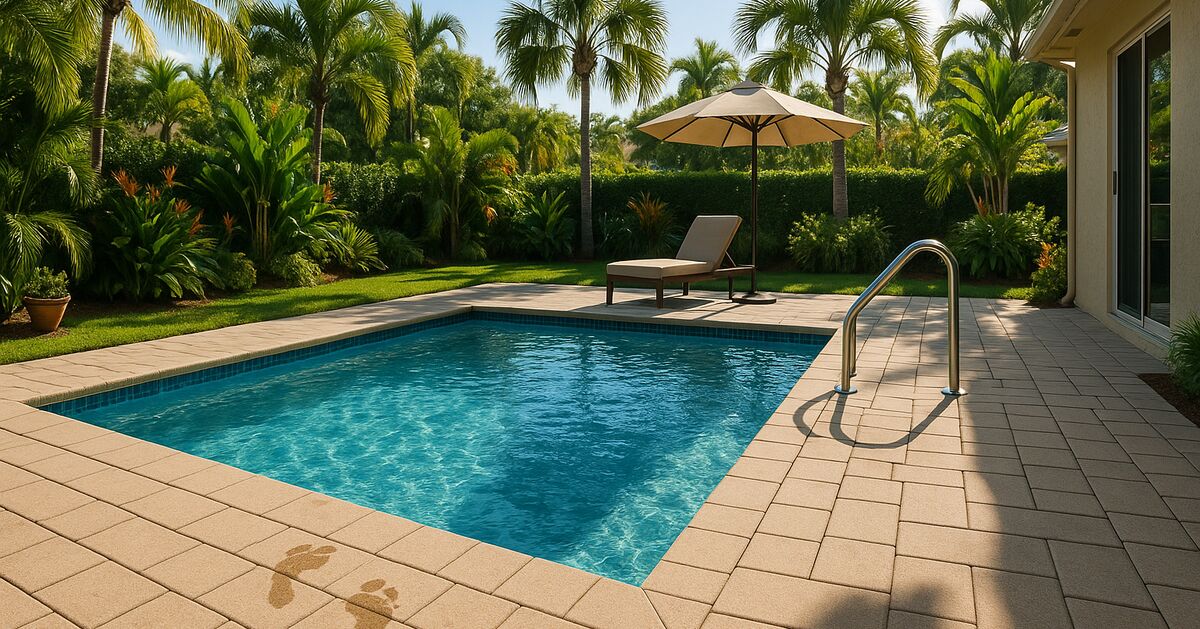
Salt is quietly eating your pool deck - and most homeowners in Lakewood Ranch, Wellen Park, and Venice don't realize it until the damage is already deep.
Saltwater pools have surged in popularity across Southwest Florida over the past decade, and for good reason. They feel softer on skin, they require less manual chlorine dosing, and they carry a reputation for being "more natural." All of that is fair. What the sales pitch skips, though, is what that salt-laden water does to the concrete, travertine, or brick pavers surrounding the pool. The deterioration is real, it is faster than most people expect, and it follows a predictable pattern once you understand the chemistry involved.
This post breaks down exactly why saltwater pool decks age harder than freshwater ones, what the failure looks like at each stage, and whether sealing the pavers actually helps - or just delays the inevitable.
What "saltwater pool" actually means for your deck
A saltwater pool is not salt-free. It uses a salt chlorine generator (sometimes called an SWG or chlorinator) that converts dissolved sodium chloride into chlorine through electrolysis. The pool water typically contains between 2,700 and 3,500 parts per million of dissolved salt. That sounds like a lot, but ocean water runs around 35,000 ppm, so it is far milder than the sea. Still, it is a continuous, low-level salt bath that the pavers around your pool are exposed to every single day.
Every splash, every wet body walking across the deck, every backwash event, every rain that carries pool water over the coping - all of it deposits salt onto and into the paver surface. In Florida's heat, that water evaporates quickly. The salt does not. It stays behind, concentrating in the pores of the paver material and in the joint sand between pavers.
The three ways salt destroys pavers
1. Salt crystallization (the invisible wedge)
This is the primary damage mechanism, and it is worth understanding in detail. When saltwater soaks into the porous body of a concrete paver or natural stone, it fills the tiny capillaries inside the material. As the water evaporates, salt crystals begin to form within those capillaries. As crystals grow, they expand. The pressure that expanding salt crystals exert on surrounding pore walls is surprisingly high - enough to fracture the material from the inside out.
The result looks like surface scaling, pitting, or a gritty, rough texture where the face of the paver used to be smooth. On concrete pavers, you will often see the sand aggregate start to show through as the cement paste erodes away. On travertine, which is a naturally porous limestone, the surface can develop a cratered appearance. This process is called subflorescence when it happens below the surface, and it is distinct from the white surface bloom called efflorescence (which we have covered separately in our post on why pavers turn white after sealing).
2. Chemical attack on the binder
Portland cement, which binds most concrete pavers together, is not especially salt-tolerant over the long term. Sodium and chloride ions work their way into the cement matrix and interfere with the hydration products that give concrete its strength. Over years of repeated wetting and drying cycles, this chemical interaction weakens the surface layer. The pavers become more brittle, more susceptible to cracking under foot traffic, and more likely to chip at their edges.
This is partly why pavers around a saltwater pool often look fine for the first two or three years and then seem to age suddenly. The damage accumulates invisibly inside the material before it becomes visible on the surface.
3. Accelerated joint sand erosion
The polymeric sand or regular jointing sand between your pavers is also vulnerable. Salt dissolves into the joint with every wet cycle and physically disrupts the sand's binding characteristics over time. Joints that once held firm begin to loosen, allowing pavers to shift slightly - which then creates small gaps where water and salt can penetrate even deeper under the surface. If you have ever noticed pavers near a saltwater pool rocking slightly underfoot, this joint degradation is often part of the story (the soil movement piece is a different issue, which we have explained in depth in the post on why pool and lanai pavers sink or shift).
Why Florida's climate makes saltwater damage worse
If you live in Sarasota, Bradenton, Nokomis, or anywhere else along our Gulf Coast stretch, your pavers face a compounding set of stressors that homeowners in cooler, drier climates simply do not deal with.
- Intense UV exposure. Florida sun degrades the surface of unsealed pavers, making them more porous and more vulnerable to salt penetration. UV also breaks down the pigments in colored concrete pavers, accelerating fading.
- Daily wet-dry cycling. Our afternoon thunderstorms and pool use mean pavers go from soaking wet to bone dry and back again, sometimes multiple times a day. Each cycle pulls salt deeper in on the wet phase and concentrates it on the dry phase.
- Year-round salt exposure. Unlike northern states where a pool is closed for six months, Gulf Coast pools run year-round. There is no winter break during which the pavers can dry out and stabilize.
- Coastal salt air. Homes closer to the water in Venice, Nokomis, and along the Bradenton waterfront are also absorbing airborne salt from the Gulf itself, stacking on top of the pool-sourced salt.
Put all of that together and it is not hard to see why a saltwater pool deck in Palmer Ranch or Parrish can show meaningful deterioration in four to six years without any protective treatment, while a similar deck in a drier, cooler climate might look fine at ten years.
Does sealing actually protect pavers from saltwater damage?
Yes - provided it is done correctly and maintained on schedule. Here is the mechanism.
A penetrating sealer (also called an impregnating sealer) soaks into the pores of the paver and chemically bonds within the capillary structure. It does not form a thick film on top. Instead, it lines the pores and makes them hydrophobic - water-repelling. When saltwater contacts a properly sealed paver, it beads up on the surface rather than wicking into the body of the stone or concrete. If the salt cannot get inside, it cannot crystallize inside, which means the primary damage mechanism described above is largely blocked.
A topical film-forming sealer (the kind that creates a wet-look or satin sheen) works differently. It forms a protective layer on top of the paver surface. This can be effective, but it has an important limitation: if water finds any pathway underneath the film (through unsealed joints, a crack, or a gap at the coping edge), salt can still get into the paver body and the crystallization damage can eventually lift the sealer from below. This is one reason proper prep work matters so much - joints need to be replenished with polymeric sand before sealing, so there are no open channels for water to sneak in.
A few things sealing does not do, and it is worth being honest about this:
- Sealing cannot reverse damage that has already happened. If the surface is already pitting or spalling, sealing stabilizes it and slows further damage, but it does not fill the pits or restore the original texture.
- Sealing needs to be reapplied. A sealer that was applied five years ago and has since worn thin is offering very little protection. In our Gulf Coast climate, resealing every two to three years is a reasonable guideline for high-exposure areas like pool decks, especially saltwater ones.
- Not all sealers are equal. A budget water-based acrylic from a big-box store applied over an improperly cleaned surface will underperform a quality solvent-based or silane-siloxane penetrating product applied by a crew that knows what they are doing. The sealer selection should match the paver type, the finish you want, and the exposure level.
What good saltwater pool deck maintenance actually looks like
If you want your pavers to hold up for the long haul, here is the practical framework.
Start with a clean, dry surface. Salt and organic debris need to be removed before sealing, not sealed over. A thorough cleaning, sometimes including a light acid wash to dissolve surface salt deposits, is often necessary around saltwater pools. We have written in detail about whether to pressure wash before sealing, including the risks of doing it incorrectly.
Re-sand the joints. If joints are depleted or eroded, fill them with polymeric sand before sealing. This closes off the hidden entry points for water and salt.
Choose the right sealer for the application. For a saltwater pool deck, a penetrating impregnating sealer is often the best first line of defense because it blocks salt infiltration from within the pore structure. Some homeowners also want a topical coat on top for aesthetics or easier cleaning - a two-coat system (penetrating base, light topical finish) can work well in the right conditions. Our overview of wet-look versus natural sealers walks through the aesthetic trade-offs in more detail.
Reseal on schedule. Mark it on the calendar. Pool decks, and especially saltwater pool decks, are one of the highest-wear surfaces a paver crew will seal. Waiting until the surface looks bad means the sealer has already been gone for a while. A two-year inspection cycle with resealing as needed is a smart approach.
Rinse the deck occasionally. This is free maintenance. After heavy pool use, a quick fresh-water rinse of the surrounding deck area dilutes and flushes surface salt before it has time to concentrate and soak in. This simple habit extends the life of both the sealer and the paver.
What to watch for - early warning signs
Catching saltwater damage early is far cheaper than dealing with it after it progresses. Here are the signs worth paying attention to on your own deck:
- A rough, gritty texture developing on pavers that used to feel smooth
- Small pits or craters appearing on the face of the paver (not just in the joints)
- A chalky or powdery residue that rinses away but keeps coming back
- Edges of pavers starting to chip or flake without any physical impact
- Joints that feel loose or allow individual pavers to move underfoot
- Any whitish bloom on the surface after drying (which may be efflorescence driven by salt movement)
If you are seeing any of these on your Lakewood Ranch pool deck, your Wellen Park outdoor living space, or anywhere else across the Gulf Coast, the time to act is now rather than after another rainy season compounds the damage.
Getting an expert eye on your specific situation
Every pool deck is a little different. The paver type, age, current sealer condition, salt system output level, and sun exposure all factor into what the right treatment looks like. Our team works with pool decks across all of our service areas from Parrish down to Venice, and we can tell you plainly what your pavers need - whether that is a straightforward reseal, a restoration cleaning first, joint replenishment, or some combination.
If you are not sure where your deck stands, start with our frequently asked questions page for quick answers, or reach out directly for a no-pressure assessment. Saltwater pool decks reward early attention. The longer salt crystallization works unimpeded inside your pavers, the more of that damage becomes permanent - and that is a much harder (and more expensive) conversation to have later.
Get started
Request a free quote
Tell us what you need. No pressure, and a real person gets right back to you.