
Why pool pavers turn orange or rust-colored on the Gulf Coast
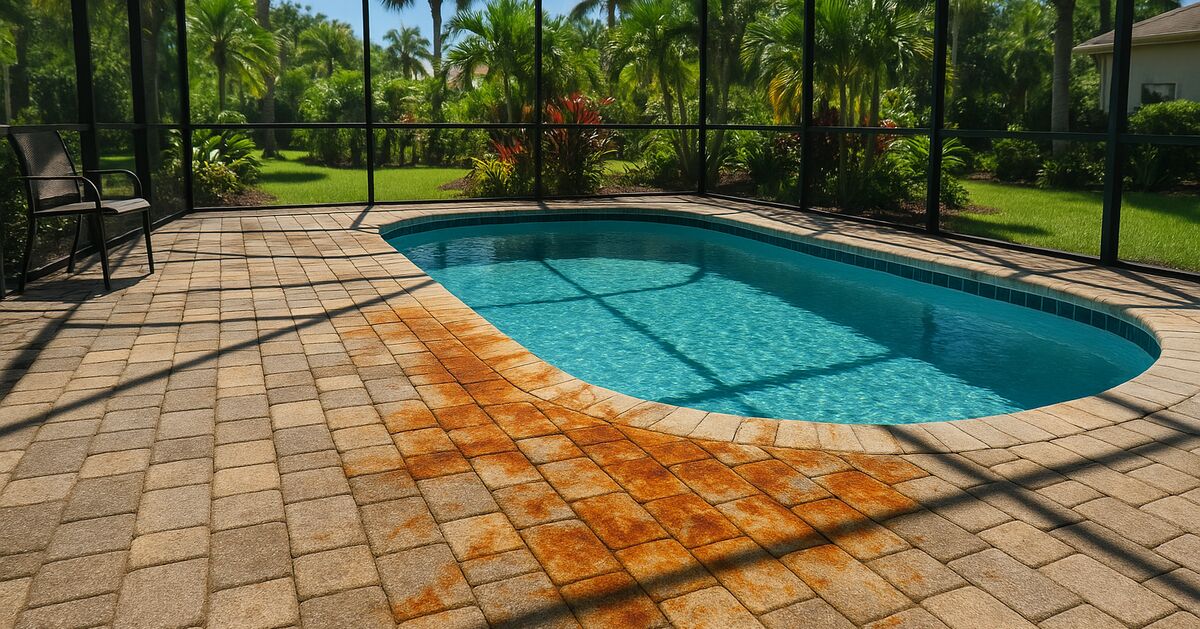
Your pool deck looked great on install day. Now there are streaks of orange, patches of rusty brown, or blotchy reddish stains spreading across the pavers, and no amount of hosing them off makes a dent. You are not alone. Rust and orange discoloration is one of the most common paver complaints we hear from homeowners across Lakewood Ranch, Venice, Sarasota, and everywhere else we work along the Gulf Coast. The good news is that this is a solvable problem. The better news is that once you understand the cause, you can stop it from coming back.
There is almost always more than one culprit
When a pool deck turns orange or rust-colored, people usually jump straight to "iron in the water." That is often part of the story, but rarely the whole story. In Southwest Florida, there are actually several overlapping sources of iron-based staining, and knowing which one is hitting your pavers changes how you treat it.
Source 1: Well water and irrigation systems
This is the single biggest driver of orange staining across our service area. Homes in Parrish, Bradenton, Lakewood Ranch, and the newer neighborhoods of Wellen Park often sit above aquifers with elevated iron content. When that water hits a dry paver surface, evaporates in our intense sun, and leaves mineral deposits behind, the iron oxidizes on contact with oxygen. The result is a rust-orange film that grows denser with every irrigation cycle. Spray heads aimed even slightly toward the pool deck are enough to cause significant staining over a single season.
Source 2: Pool water chemistry and splash-out
Pool water is not pure H2O. It carries sanitizers, pH adjusters, metals from copper-based algaecides, and, in older pools, trace metals from aging equipment. Every time a wave of water slaps onto the deck and dries in the Florida heat, it leaves a microscopic residue behind. Over weeks and months those deposits accumulate. Iron and manganese, both of which occur naturally in our regional groundwater and end up in pool fill water, are the main offenders. Copper from algaecides produces a greenish tint, but when it mixes with iron compounds the result can lean orange or brown.
Source 3: The pavers themselves
Concrete pavers are made with Portland cement, aggregates, and pigments. Some of those aggregates, particularly certain sands and crushed limestone sourced from Florida, carry trace iron content. When the paver surface is repeatedly wetted and dried, especially in the first few years after install, that internal iron can migrate outward. This is sometimes called "bleeding" and produces a uniform, slightly rusty cast across the whole paver face rather than the streaky pattern you get from an external water source.
Source 4: Screen enclosure and metal hardware
Steel screws, aluminum extrusions, and the metal anchors used in screen enclosures all rust when they get wet. Rain and hose water carry that rust down the frame, across the deck, and right into the paver joints. The stains from this source are usually linear, following the drip pattern from the frame. Look for vertical orange streaks near the base of your cage posts.
Why the Gulf Coast makes this so much worse
Homeowners who move here from other states are often surprised by how fast staining happens. There are a few reasons Southwest Florida is unusually harsh on pavers:
- Intense UV and heat. Our sun accelerates evaporation, which means mineral-laden water dries almost immediately, leaving a concentrated deposit behind rather than running off.
- High humidity but rapid surface drying. The contrast between humid air and a sun-baked paver surface creates cycles of moisture absorption and rapid drying that draw minerals through the paver material repeatedly.
- Rainy season flooding. From June through September, heavy daily rains wash iron-rich soil and mulch across pool decks, especially in newer communities still establishing their landscaping.
- Local water supply. Manatee and Sarasota counties draw from surface water that is treated, but many private wells and irrigation systems tap shallow aquifers with measurable iron and manganese levels.
Can sealing prevent orange and rust staining?
Yes, but with an important caveat: sealing prevents new staining. It does not fix staining that is already there. This is a distinction worth understanding before you spend money on any treatment.
A quality penetrating or film-forming paver sealer works by filling the microscopic pores in the paver surface. Those pores are what allow iron-laden water to soak in, deposit minerals at depth, and stain from the inside out. When the pores are sealed, water beads and rolls off instead of absorbing. The iron never gets a chance to bind to the paver material.
Film-forming sealers (the kind that create a visible sheen, sometimes called wet-look sealers) are particularly effective for pool decks because they lay a physical barrier across the entire surface. Penetrating sealers work from within the paver and are excellent for high-traffic areas where a surface film might wear unevenly. Both types dramatically reduce staining when applied correctly to a clean, dry surface.
You can read more about the full range of treatments we offer on our paver sealing and restoration services page.
The order of operations matters enormously
This is where a lot of DIY attempts go wrong. People see orange stains, buy a bottle of sealer at the hardware store, apply it over the top, and lock the stain in permanently. Now they have an orange deck with a shiny coat on it and the stain is sealed beneath the surface.
The correct sequence is:
- Identify the source. Is it irrigation overspray? Splash-out? Bleeding from within the paver? The treatment chemistry is different depending on the source.
- Remove the existing stain. Iron and rust stains require an acid-based or chelating cleaner specifically formulated for mineral deposits. General-purpose paver cleaners or pressure washing alone will not lift them. The stain needs to be chemically dissolved, not just scrubbed.
- Rinse and neutralize. Acid cleaners must be thoroughly rinsed and the surface neutralized before sealing, or the remaining acid will continue reacting beneath the sealer.
- Allow complete drying. In Florida, this typically means waiting at least 24 to 48 hours after cleaning, depending on weather conditions. Sealing over any residual moisture traps it and can cause whitish hazing or adhesion failure. If you want more detail on that particular problem, our post on why pavers turn white after sealing goes deep on the topic.
- Apply sealer. Two thin coats are almost always better than one thick one. A thick coat traps off-gassing from the paver material and is more prone to bubbling and peeling.
There is also a prior question worth asking: does the deck need a full reseal, or primarily a targeted clean first? Our post on whether your pavers need resealing or just a deep clean can help you work through that decision.
Addressing the source, not just the surface
Sealing is a protective layer, not a permanent force field. If the source of iron is not addressed, staining will eventually work its way back, because no sealer lasts forever. Here is what we recommend alongside sealing:
- Adjust irrigation heads so they do not spray onto the deck. Even redirecting them a few inches can eliminate the primary staining source entirely.
- Install an iron filter or softener on well-water irrigation lines if iron levels are high. This is a plumbing upgrade, not a paver decision, but it is often the single most impactful step a homeowner can take.
- Check pool chemistry regularly. Keep iron and copper levels in the pool water within normal ranges. If you are using a copper-based algaecide, talk to your pool service about alternatives.
- Inspect screen enclosure hardware annually. Replace rusting screws and anchors before they start contributing runoff to the deck surface.
- Rinse the deck after heavy rain. A quick rinse during rainy season removes iron-rich surface water before it has a chance to evaporate and deposit.
What professional treatment looks like versus DIY
Homeowners in Nokomis, Palmer Ranch, and other areas sometimes ask whether this is a job they can handle themselves. Honestly, the cleaning step is where professional treatment makes the biggest difference. Correctly dosing and applying a rust-removing acid cleaner on a paver deck, around a pool, near equipment and landscaping, takes experience. Too strong a mix can bleach pigment from the paver or etch the surface. Too weak and you simply do not lift the stain.
Professional sealing contractors also have access to commercial-grade sealers that are not available in retail stores. These products have higher solids content, better UV resistance, and longer service life than anything you can pick up locally.
If you are in Lakewood Ranch dealing with irrigation staining, or in Wellen Park with a brand-new community pool deck that is already showing orange patches, or anywhere else across our service area, a professional assessment before you spend money on the wrong product will save you a lot of frustration.
How long does protection last?
A properly prepared and sealed pool deck in our climate should stay protected for two to three years under normal conditions. High traffic, strong sun exposure, and continued irrigation overspray will all shorten that window. Decks that have more shade, less foot traffic, and corrected irrigation sources often go longer between treatments.
Our post on how often to reseal pavers in Southwest Florida covers this in detail, including how to tell when the sealer is losing effectiveness and it is time for another application.
A note on saltwater pools
If your pool uses a saltwater chlorination system, you have an additional factor at play. Salt accelerates the breakdown of some sealer types and can contribute to surface corrosion of pavers over time. Not all sealers are rated for saltwater pool environments. This is worth discussing specifically when choosing a sealer product, because the wrong choice will not just fail to protect, it can actively trap salt beneath the surface and accelerate damage. We have covered this topic in more depth in our post on why saltwater pool pavers deteriorate faster.
The bottom line
Orange and rust-colored staining on Gulf Coast pool pavers is almost always iron-based, and it comes from one or more of four sources: iron-rich irrigation water, pool water chemistry, trace iron in the paver material itself, or rusting hardware in the screen enclosure. Sealing is highly effective at preventing it, but only when the existing stain is properly removed first and the source of iron is addressed.
If you are looking at an orange-stained pool deck right now and wondering where to start, the most useful first step is a site visit to identify exactly what is causing it. We serve homeowners across Sarasota, Bradenton, Venice, and the surrounding Gulf Coast communities, and we are always glad to take a look and give you a straight answer before recommending any treatment.
You can learn more about our approach on our services page or reach out to schedule a free assessment. No hard sell, just an honest look at what your pavers need.
Get started
Request a free quote
Tell us what you need. No pressure, and a real person gets right back to you.