
Why pool pavers get slippery when wet - and how sealing helps
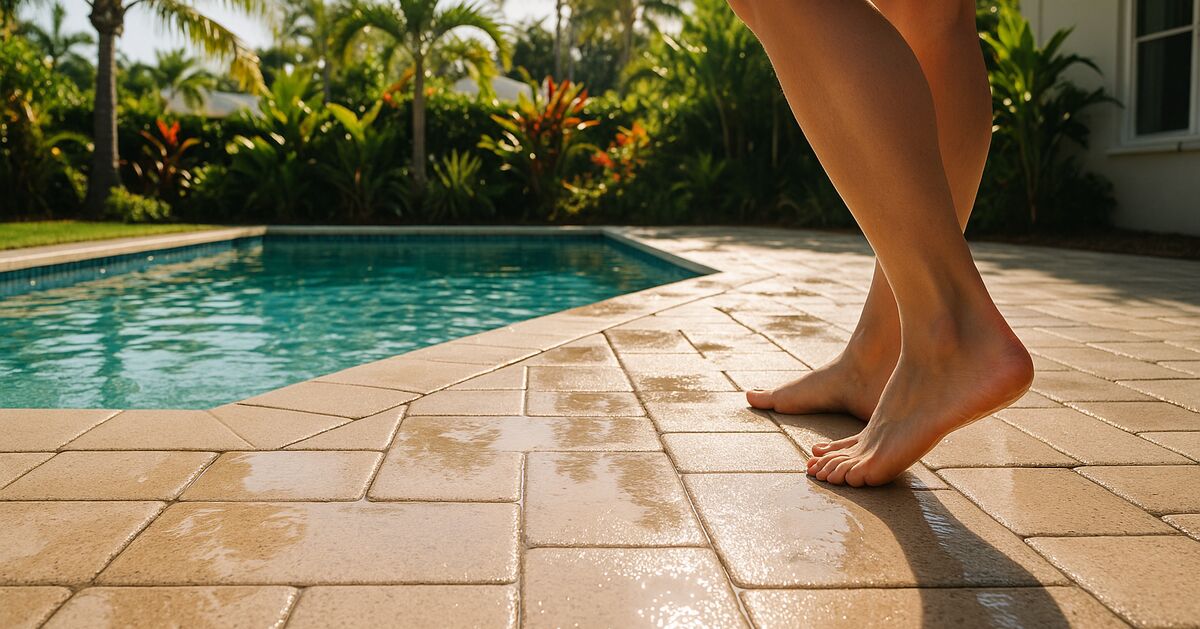
Bare feet, wet pavers, and a hard concrete edge - it's a combination that sends people to urgent care every summer across Sarasota, Bradenton, and Lakewood Ranch. If your pool deck feels like a skating rink when it's wet, that slipperiness didn't happen overnight, and it isn't just about the pavers themselves. Several forces specific to the Gulf Coast environment are working together to rob the surface of its grip. Understanding those forces is the first step to fixing the problem safely and permanently.
What actually makes a paver slippery?
Pavers, fresh from the factory, are not naturally slick. Most concrete and travertine pavers have a slightly open, textured surface that gives bare feet a decent grip even when damp. The slipperiness you feel on a well-used pool deck is almost always caused by something that has colonized or coated that surface texture. On the Gulf Coast, the usual suspects are:
- Algae and biofilm. Green, black, or grayish algae thrive anywhere they find moisture, warmth, and a little organic matter - dead skin cells, sunscreen residue, windblown pollen. Southwest Florida gives them all three in abundance, essentially twelve months a year. Even a thin, nearly invisible layer of algae produces a slimy coating that feels like wet bar soap underfoot.
- Mineral deposits and efflorescence. Hard water from irrigation systems leaves behind calcium and mineral buildup that can form a slightly crystalline, uneven crust. This crust can actually reduce visible texture while creating micro-slick patches, especially when wet. If you've noticed white or chalky residue on your pavers, our post on why pavers turn white after sealing - efflorescence and haze explained goes into this in detail.
- Mold and mildew. Shadier sections of a pool deck - under a pergola, near a screen enclosure wall, or between a lanai and a hedge - stay damp longer and attract mold. Mold is just as slippery as algae and often more stubborn.
- Old, worn sealer. A sealer that was applied years ago and has since degraded can leave behind a peeling, uneven film. That film fills in the surface texture of the paver and can become extremely slick when wet. This is one of the most common causes of sudden slipperiness on a deck that used to feel fine.
- Sunscreen, body oils, and pool chemicals. These accumulate over a season. They don't cause slipperiness on their own, but they feed algae growth and soften old sealer, accelerating every other problem on this list.
Why the Gulf Coast makes all of this worse
Humidity in the Sarasota and Bradenton area rarely drops below uncomfortable. Even on a "dry" winter day, moisture condenses on pavers overnight and lingers in shaded corners well into the afternoon. That persistent dampness is a near-perfect incubator for algae and biofilm. Pool decks in Venice and Nokomis that face west get blazing afternoon sun, which dries the surface quickly - but the east-facing or screen-enclosed sections of the same deck may stay damp for six or eight hours after a splash.
Sarasota and Manatee County also sit in the middle of Florida's thunderstorm belt. The rainy season runs from roughly June through September, but scattered afternoon storms continue well into October and November. That means pool decks are cycling through wet-dry-wet patterns almost constantly for more than half the year, which accelerates biofilm growth dramatically compared to drier climates.
The region's water supply - particularly in communities that rely on irrigation wells - is notoriously hard. Calcium and magnesium in well water leave mineral deposits on pavers that gradually change the surface texture. Homeowners in Parrish and Lakewood Ranch with automated irrigation systems that spray across the pool deck are especially prone to this, because the sprinkler schedule runs whether or not it rained the night before.
Can sealing actually fix slippery pavers?
Yes - but only if it's done right and only if the right product is chosen. This is worth spending some time on, because the answer surprises some homeowners.
First, the cleaning has to come before the sealing. A sealer applied over algae, mold, or mineral deposits locks those contaminants in place and can actually make the surface more slippery, not less. A proper job starts with a thorough, professional cleaning - usually a controlled pressure wash combined with appropriate cleaning agents - to strip away every bit of biofilm, staining, and loose debris before a drop of sealer touches the surface. Our guide on whether your pavers need resealing or just a deep clean first is worth reading if you're not sure where your deck stands.
Second, the sealer itself has to include a non-slip additive or have an inherently matte, penetrating finish. This is where product selection matters enormously. There are two broad categories of paver sealer:
- Film-forming sealers sit on top of the paver surface and can create a glossy or wet-look appearance. These products, when applied correctly on a clean surface, seal out moisture and staining agents beautifully. However, a high-gloss film-forming sealer on a smooth travertine paver can actually reduce traction compared to the bare stone. For pool deck applications, a quality contractor will either choose a lower-sheen film-forming product or add a non-slip aggregate (fine silica sand or polymer beads) to the sealer before application.
- Penetrating sealers soak into the paver rather than sitting on top. They don't change the appearance much, and because they don't alter the surface texture, they preserve the original grip of the paver. They also tend to resist algae re-growth better in heavily shaded or persistently damp areas. The trade-off is that they don't enhance color or give that rich, just-wet look.
For most Gulf Coast pool decks, the best outcome usually comes from a penetrating or low-sheen sealer with a non-slip additive in areas around the pool edge, steps, and any raised spa or feature. A contractor who is familiar with paver sealing and restoration across the Gulf Coast will know which combination makes sense for your specific deck layout, paver material, and how the space is actually used.
The non-slip additive question
Non-slip additives deserve their own explanation because there's some confusion about them. The additive is typically a fine, angular sand or polymer bead that is broadcast into the wet sealer or mixed in before application. When the sealer cures, those particles are locked at the surface, creating micro-texture that grips even wet bare feet. The particle size matters: too coarse and it's uncomfortable to walk on; too fine and it doesn't add meaningful traction. A reputable contractor will match the aggregate to the application.
One thing to understand is that non-slip additives do require reapplication over time. As the sealer wears, the surface particles can be walked off or washed away, reducing the grip benefit. This is one reason why regular maintenance sealing every two to three years (or as appropriate for your deck's conditions) keeps the safety benefit intact, not just the cosmetic benefit.
Common mistakes that make slipperiness worse
A few errors show up regularly on Gulf Coast pool decks, and they're worth naming because homeowners sometimes make them with the best intentions:
- Pressure washing without sealing afterward. A good pressure wash removes algae and restores grip temporarily, but it also opens the paver surface and cleans away any remaining old sealer. An unsealed paver re-colonizes with algae faster after cleaning than a properly sealed one does. The clean deck feels great for a few weeks and then becomes slippery again, often worse than before.
- Applying sealer over a damp surface. Florida's humidity makes this surprisingly easy to do. If the pavers aren't fully dry before sealing, moisture gets trapped under the film and creates a cloudy, uneven finish that can peel and flake - and flaking sealer is extremely slippery. Timing the job for a stretch of dry weather and allowing adequate drying time is critical. This is explained further in our post on pressure washing pavers before sealing in Florida.
- Using a big-box store sealer not rated for pool deck use. Not all sealers are formulated for constant wet exposure and pool chemistry. A product designed for a driveway or patio may not hold up to daily water exposure, chlorine splash, and UV intensity around a pool. It can break down faster and leave a worse surface than no sealer at all.
- Skipping the steps and pool edge. These are statistically the most dangerous spots on any pool deck. They're also the spots most often treated inconsistently, because they're awkward to spray or roll. Making sure the non-slip application is thorough on steps, raised edges, and transition areas is non-negotiable for a safe result.
What to expect from a professional job
When a professional handles a slippery Gulf Coast pool deck from start to finish, the process generally looks like this:
- Inspection. Assess the paver type, existing sealer condition, degree of biological growth, and any areas of settling or damage. (If you're seeing sinking or shifted pavers, that's a separate issue covered in why pool and lanai pavers sink or shift.)
- Cleaning. Pressure wash with appropriate technique and, where needed, apply targeted treatments for algae, efflorescence, or staining.
- Dry time. Pavers must be fully dry before sealer is applied.
- Sealer application. The right product, properly mixed with non-slip additive if needed, applied in the correct number of coats and at the correct rate for the paver type.
- Cure time. Typically 24 to 48 hours before foot traffic, longer before pool furniture is placed back.
The result should be a deck that looks better, resists re-growth significantly longer, and most importantly, is safe to walk on in wet bare feet. Homeowners across Wellen Park, Palmer Ranch, and Venice with travertine, concrete, or brick pavers around their pools have all seen this outcome when the job is done with proper products and preparation.
When sealing alone is not enough
Sealing addresses the surface. It doesn't address structural problems, chronic drainage issues, or pavers that have become extremely smooth through years of heavy foot traffic and polishing. If your travertine has been ground down to a near-mirror finish by years of pool traffic, even an aggressive non-slip additive will only go so far. In that case, a conversation about resurfacing or replacing the most worn sections is worth having before you invest in sealing.
Similarly, if water is pooling on your deck rather than draining away from the pool coping, the persistent standing water will accelerate algae growth regardless of how good the sealer is. Drainage grading should be addressed at the same time as sealing whenever possible.
The bottom line
Slippery pool pavers on the Gulf Coast are almost always caused by biological growth, old or degraded sealer, or a combination of both - not by the pavers being inherently unsafe. Proper cleaning followed by the right sealer with appropriate non-slip treatment is a genuine, lasting fix for most decks. The key words are "right sealer" and "proper cleaning," because cutting corners on either one produces a result that is, at best, temporary and at worst, more hazardous than the original problem.
If you're in Sarasota, Bradenton, Lakewood Ranch, or anywhere else on the Gulf Coast and your pool deck has become a slip hazard, the Gulf Coast Paver Sealing team is happy to take a look and give you an honest assessment of what it will take to make it safe and keep it that way.
Get started
Request a free quote
Tell us what you need. No pressure, and a real person gets right back to you.