
Why pool pavers fade on the Gulf Coast - and what sealing can actually do
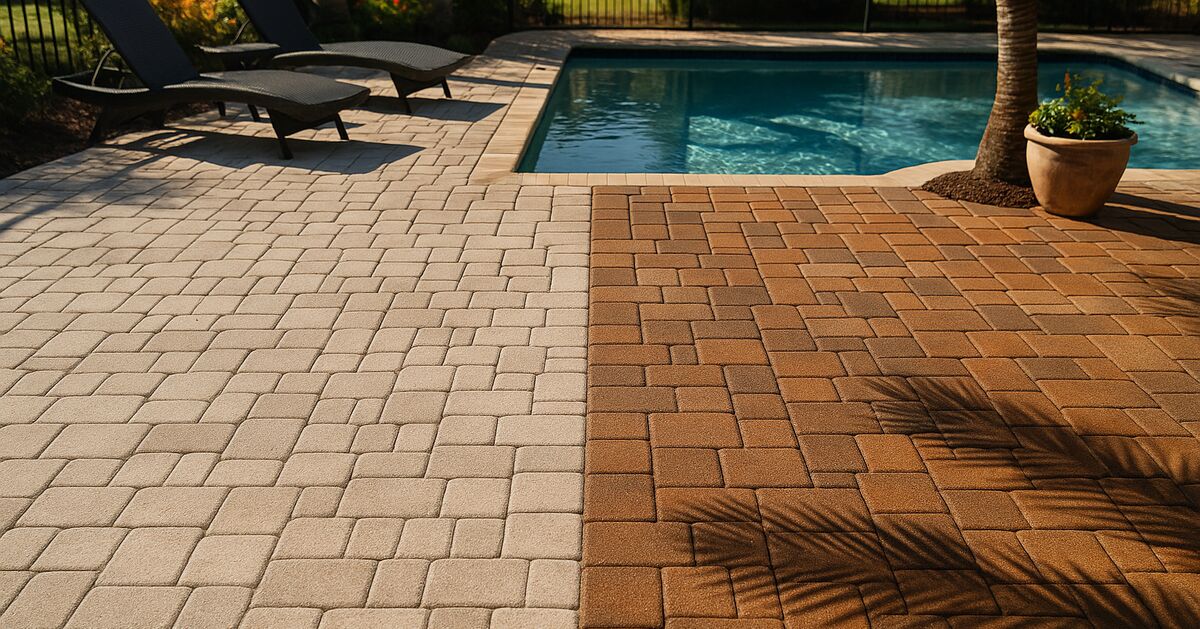
Your pool deck looked rich and warm the day it was installed. Now, a few years later, it looks like it was left out in the bleach. That slow color drain is one of the most common complaints we hear from homeowners across Sarasota, Lakewood Ranch, Venice, and Bradenton - and it raises a very reasonable question: is the color gone for good, or can it come back?
The honest answer is "it depends," and this post is going to walk you through exactly what it depends on. Understanding why pavers fade helps you make a smarter decision about whether cleaning and sealing can restore what you had, or whether you're managing expectations going forward.
The Gulf Coast is genuinely brutal on paver color
Southwest Florida is not like the rest of the country. The combination of factors here is almost perfectly designed to strip pigment from concrete and clay pavers:
- UV intensity. Florida sits at a lower latitude and under a thinner ozone column than most of the U.S. The UV index regularly hits 10 or 11 from March through October. Sustained UV radiation is the single biggest driver of color fade in any outdoor surface, pavers included.
- Reflected UV from water. A pool amplifies the problem. Water reflects UV light back up onto the pavers from below, so your deck is getting hit from both the sky and the pool surface at the same time. This essentially doubles the UV exposure compared to a driveway or walkway.
- Heat cycling. Pavers in Sarasota or Wellen Park routinely hit surface temperatures of 140 to 160 degrees Fahrenheit on a summer afternoon. That thermal stress opens microscopic pores in the material and accelerates the breakdown of pigment binders.
- Frequent wetting and drying. Between pool splashing, afternoon thunderstorms, and morning dew, Gulf Coast pool pavers go through far more wet-dry cycles than pavers in drier climates. Each cycle leaches water-soluble minerals and pigment particles from the surface layer.
- Chlorine and pool chemistry. Splash-out water carries chlorine, pH-adjusting chemicals, and algaecides. These compounds are mildly caustic at pool concentrations. Over years of contact, they do real work on the surface layer of pavers, breaking down the color-bearing aggregate and cement paste.
- Humidity and biological growth. Algae, mildew, and biofilm grow fast in our climate. They produce organic acids that etch the paver surface and, over time, dull the finish even before the color itself is visibly gone.
Any one of these factors would cause some fading. All of them together, running continuously for 10 or 11 months a year, is why pool decks in Nokomis, Palmer Ranch, and Parrish can look noticeably faded within three to five years of installation.
What is actually fading - the surface or the whole paver?
This matters a lot, because it changes what can be done about it.
Concrete pavers are manufactured with pigment blended into the mix, but the color-rich material is concentrated near the surface. The very top layer - sometimes just a millimeter or two - contains the densest concentration of dye and the finest aggregate particles. Below that, the paver is structurally the same but visually more neutral.
When UV, heat, and chemicals attack the surface, they're essentially abrading and bleaching that thin top layer. If the degradation is shallow, the visual effect can be dramatic - the paver looks washed out - but the underlying color is still there waiting, covered by a layer of chalky, degraded cement paste and mineral deposit.
If the degradation is deep, or if years of pressure washing have physically removed that top layer, the "original" color layer is gone and cannot be restored by sealing alone.
Clay brick pavers behave a bit differently. Their color comes from iron oxide compounds baked into the clay, which are generally more UV-stable than concrete dyes. Clay pavers still fade on Gulf Coast pool decks, but the mechanism is more about surface mineral deposit, algae staining, and efflorescence masking the true color than UV destroying the pigment itself. That's actually good news for clay paver owners, because cleaning alone often does most of the work.
The role of efflorescence in what looks like fading
A lot of what homeowners describe as "fading" is actually efflorescence - the white or gray mineral haze that migrates to the paver surface as water evaporates. On a pool deck, this process is constant. Water soaks in, dissolves calcium carbonate and other salts from within the paver or the bedding sand below, and as it evaporates at the surface, it leaves those minerals behind as a dull, chalky film.
Efflorescence doesn't destroy color. It buries it. A paver covered in efflorescence can look completely washed out, but once the mineral deposit is properly removed, the original color can be surprisingly intact. This is why a professional cleaning - not just a garden-hose rinse, but a proper chemical wash and pressure treatment - sometimes produces results that look like a near-total color restoration even before any sealer is applied.
If you want the full story on why pavers develop that white haze, we've covered it in detail in our post on why pavers turn white after sealing and what efflorescence really is.
Can sealing restore faded color - or only protect from here?
Here's the straightforward answer: sealing can visually restore color that has been masked or muted, but it cannot regenerate color that has been physically destroyed.
Think of it this way. A quality penetrating or film-forming sealer saturates the top layer of the paver and changes how light interacts with it. Dry, oxidized pavers scatter light diffusely, which makes them look pale and lifeless. A sealer fills those micro-voids, reduces that scattering, and causes the paver to reflect light in a way that reveals the underlying color. It's the same reason a wet stone on the beach looks richer than the same dry stone - water in the pores changes the optical behavior of the surface.
So if your pavers have faded because their surface is oxidized, chalky, and mineral-crusted, the right cleaning followed by the right sealer can make a very significant difference. Homeowners in Lakewood Ranch and Venice are often genuinely surprised by how much color comes back after a professional prep-and-seal job on pavers they thought were beyond help.
The limit is this: if the UV and chemical damage goes deep enough that the pigment layer itself is destroyed, or if aggressive pressure washing has removed that surface layer entirely, sealing will enrich what's left but won't restore the original appearance. The color that isn't there can't be revealed. In those cases, the realistic outcome is a modest improvement in appearance and strong protection against any further deterioration.
The best way to know which situation you're in is to wet a section of the paver yourself with plain water. If the color improves noticeably when wet, there's likely good color remaining in the material - it's just being masked. A sealer mimics and then makes permanent that "wet look," to whatever degree you choose. If the pavers look nearly the same wet and dry, the pigment layer has been more severely compromised.
How cleaning fits into the picture
We cannot overstate how important proper cleaning is before any sealing happens. Applying sealer over a dirty, mineral-crusted, or algae-stained surface locks all of that in. The sealer enhances whatever it covers, including the bad stuff. We've written about whether pavers need resealing or just a deep clean first - and the honest answer is that cleaning always comes first, and sometimes it's enough on its own.
For Gulf Coast pool decks specifically, a proper pre-sealing clean typically involves:
- A chemical efflorescence treatment to dissolve mineral deposits without etching the paver
- A controlled pressure wash to remove algae, biofilm, and loose surface material - with the pressure and angle calibrated to clean without stripping the surface layer
- A joint sand inspection, because cleaning can dislodge polymeric sand and that needs to be addressed before sealing
- Adequate dry time, which in Florida's humidity takes longer than most people expect
The question of whether you can pressure wash pavers before sealing them in Florida is one we've covered separately, because the answer really does matter here. Too much pressure from too close removes the very surface layer you're trying to protect and restore.
Which sealer finish works best for faded pavers?
If your goal is color restoration, the finish you choose matters. A wet-look or gloss sealer gives the most dramatic color enhancement because it has the highest refractive effect on the paver surface. A natural-look or matte sealer still enriches color, but more subtly.
For heavily faded pavers where you're trying to recover as much visual warmth as possible, a quality wet-look sealer applied after thorough cleaning often gives the most satisfying result. For pavers that are only lightly faded or where you prefer a more understated appearance, a natural-finish penetrating sealer makes sense.
The product category also matters. Film-forming sealers sit on top of the paver and create that glossy, enriched look. Penetrating sealers soak in and provide protection with a more natural surface appearance. Each has trade-offs in terms of maintenance, reapplication frequency, and how they handle the slip risk around a pool - something we've covered in our post on why pool pavers get slippery and how sealing affects that.
What you can expect going forward after sealing
Once properly cleaned and sealed, pavers in our Gulf Coast climate do need attention on a reasonable schedule. A quality seal job on a pool deck typically holds up for two to four years before the protective layer begins to thin and the enhanced color starts to dull again. The exact interval depends on the sealer product, the sun exposure the deck gets, how heavily the pool is used, and whether the deck gets covered or stays fully exposed.
The important thing to understand is that each resealing cycle is far easier than the original restoration. Maintenance sealing on a clean, already-sealed surface is straightforward. It's the first job - the one where you're cleaning years of oxidation and mineral buildup and trying to recover faded pavers - that requires the most work and the most judgment about products and technique.
The good news: pavers that are kept on a regular cleaning and sealing schedule rarely reach the point of severe, irrecoverable fading. Sealing is genuinely preventive as well as restorative. You're blocking UV penetration, reducing the wetting-and-drying cycle's impact on the surface, and creating a barrier against pool chemistry. That's why we always say the best time to seal is before the pavers look bad - but the second-best time is now.
What to do if you're not sure where your pavers stand
If you're a homeowner in the Sarasota, Bradenton, or Venice area looking at a pool deck that's gone from warm and vibrant to chalky and pale, the first step is getting a professional assessment. An experienced eye can tell you pretty quickly whether you're dealing with surface masking (treatable) or genuine pigment loss (manageable), and what the realistic outcome of a clean-and-seal job looks like.
You can browse all the areas we serve or go straight to our services page to understand what a professional paver sealing and restoration job actually involves. And if you have specific questions about your situation, the FAQ covers a lot of common scenarios, or you can simply get in touch with us directly for a no-pressure conversation about your deck.
The goal is always to give you an honest picture of what's achievable - not to promise a miracle, but also not to underestimate what a proper job can do for pavers that have been given up on too soon.
Get started
Request a free quote
Tell us what you need. No pressure, and a real person gets right back to you.