
Brick pavers vs. concrete pavers on the Gulf Coast: do they need different sealing approaches?
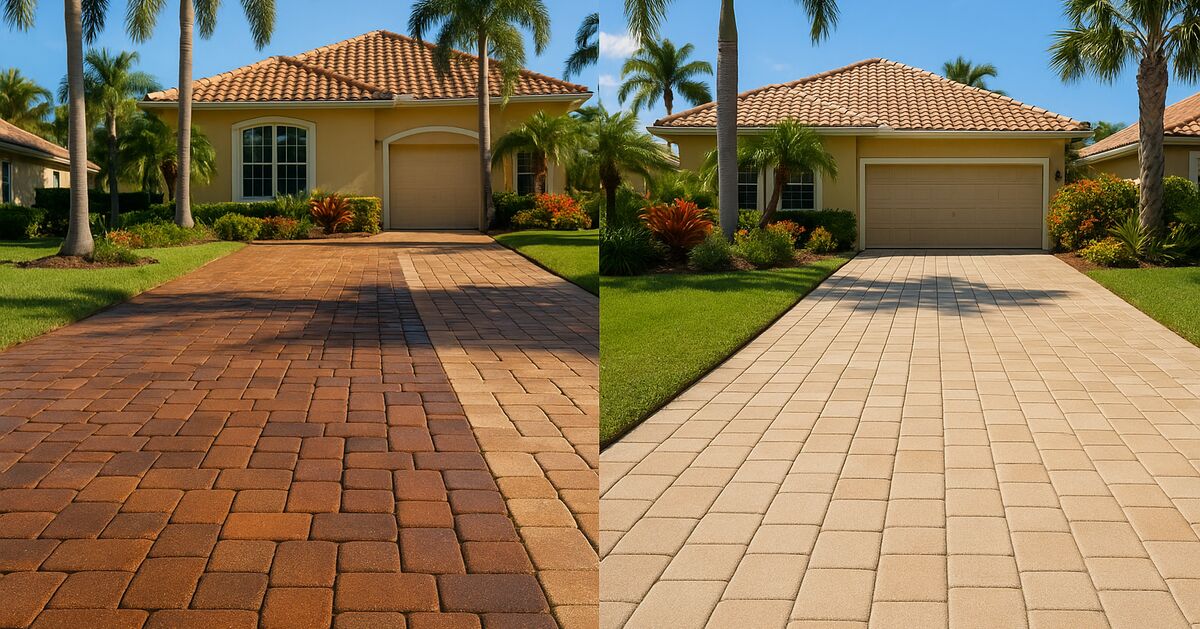
Florida sun finds every weakness in a paver. The question is whether it finds the same weaknesses in a clay brick paver as it does in a concrete paver, and the honest answer is: not quite. The materials are fundamentally different, and those differences show up in how each one fades, absorbs moisture, reacts to sealer, and ultimately holds up over years of Gulf Coast summers.
If you're trying to figure out the right sealing approach for your driveway, walkway, or pool deck in Sarasota, Bradenton, Venice, or anywhere else along this stretch of coast, understanding the "why" behind the material difference will save you from picking the wrong product or skipping a step that actually matters.
What brick pavers and concrete pavers are actually made of
Clay brick pavers are fired in a kiln at very high temperatures, a process that fuses the clay particles into a dense structure. That firing process fuses the clay particles into a dense, vitrified structure. The color in a true clay brick is mineral-based and runs all the way through the paver, not just on the surface. This matters a lot in a climate like ours.
Concrete pavers are made from portland cement, aggregates, and pigment, then compressed under high pressure and cured. They are strong, but they are not vitrified the way clay brick is. The pigment sits in the cement matrix and can be affected differently by UV exposure and chemical contact. Concrete pavers are by far the more common choice in new construction across Southwest Florida, from the newer subdivisions in Wellen Park to the established neighborhoods in Lakewood Ranch.
Both materials are porous to some degree, but in different ways, and that porosity is at the heart of how sealing works for each.
Porosity: the key difference that drives everything else
Porosity is not one simple thing. It refers to both the total void space in a material and the size and connectivity of those voids. Clay brick pavers tend to have relatively low, fine porosity because of that high-heat firing process. Concrete pavers, especially standard residential grades, tend to have higher and more open porosity. The cement matrix holds more air voids that water, salt, and biological material can enter.
On the Gulf Coast, this plays out in a few specific ways:
- Salt air infiltration. In coastal communities like Venice, Nokomis, and along the bayfront in Sarasota, airborne salt particles settle on pavers constantly. Concrete pavers absorb that salt into their more open pore structure, and when moisture cycles in and out, those salts can crystallize inside the paver and eventually cause surface spalling. Brick pavers are more resistant to this by nature, but they are not immune.
- Efflorescence. This is the white haze that appears when soluble salts migrate through a paver and deposit on the surface. Concrete pavers are more prone to efflorescence than clay brick because the cement itself contains calcium compounds that dissolve in water and travel outward. If you have seen white streaks or a chalky film on concrete pavers, this is usually the cause. Proper sealing helps slow it significantly by reducing the moisture infiltration that drives the migration process.
- Moisture retention. Concrete pavers can hold more moisture longer. In a humid climate where the surface rarely gets truly dry for long stretches, this means biological growth (algae, mildew, mold) tends to colonize concrete pavers a little more aggressively than well-fired clay brick. You can read more about the algae problem specifically in our post on why lake-view pavers grow algae faster and whether sealing helps.
How UV fading works differently on each material
UV degradation is one of the most persistent problems for any outdoor surface in Southwest Florida. This region sees intense sun exposure, and the UV index regularly reaches very high levels during summer months, according to the EPA's UV Index scale and guidance.
For concrete pavers, the pigment is blended into the cement mix, which means it is sitting in a matrix that is itself subject to carbonation and surface wear. UV breaks down the binder holding the pigment particles in place at the surface, and the color visibly fades. This is why a concrete paver driveway that looked rich and deep-toned when it was installed can look washed out and chalky five or six years later with no sealer protection.
For clay brick pavers, the color is mineral-based and fired in. UV light cannot "bleach" an iron oxide mineral the way it can break down organic or synthetic pigment in a cement matrix. Clay brick pavers do change appearance over time under UV exposure, but the change tends to be more of a weathered, slightly muted tone rather than a dramatic fade. They are genuinely more UV-stable than most concrete pavers.
This distinction matters for sealer selection. On concrete pavers, a sealer with strong UV-blocking properties is doing double duty: it is protecting the surface from moisture infiltration AND slowing the photodegradation of the pigment. On clay brick pavers, the UV-protection role of the sealer is less critical for color preservation, though it still plays a role in protecting joint sand stability and surface integrity.
Sealer types and which work best for each material
Not every sealer is appropriate for both material types. Here is how the common categories shake out in practical terms for Gulf Coast applications.
Penetrating / impregnating sealers soak into the pore structure and create a hydrophobic barrier below the surface. They do not change the appearance of the paver much. These work well on both brick and concrete pavers, and they are particularly well-suited to clay brick because they do not add a surface film that could peel or cloud (since the brick surface is harder and less flexible than a film-forming sealer over it). Penetrating sealers are also a strong choice for any surface where slip resistance is a concern, such as pool decks.
Film-forming sealers sit on top of the surface and create a protective layer. These come in solvent-based and water-based formulations, and they produce everything from a natural matte look to a high-gloss wet look. Film-forming sealers work well on concrete pavers and can significantly revive faded color by locking in what remains and adding visual depth. On clay brick pavers, the application requires more care: a fired brick surface is less porous, which means adhesion is more critical. If a film-forming sealer is applied to a brick surface that was not properly cleaned and prepped, adhesion failures (peeling, flaking, clouding) happen faster. Our blog has an in-depth look at exactly what goes wrong in these situations in the post on sealing over old sealer without stripping and the exact failure modes.
Acrylic sealers are a common subcategory of film-forming products and are widely used on concrete pavers throughout this region. They provide good UV protection and color enhancement. On clay brick, they can work but need to be properly matched to the brick's lower absorbency. Using a high-solids acrylic meant for very porous concrete on a dense clay brick can result in pooling, uneven sheen, or adhesion problems.
Polyurethane and epoxy-modified sealers offer excellent durability and are sometimes used on high-traffic applications. These require careful application and can be less forgiving on brick surfaces if any moisture is trapped during curing.
Surface preparation: where the real differences live
Here is something that does not get enough attention: the prep work for clay brick pavers is different from the prep for concrete pavers, and skipping the right prep for each material is where a lot of sealing projects fail.
Concrete pavers frequently need treatment for efflorescence before sealing. If you seal over active efflorescence, you trap the salts and the problem continues underneath, eventually lifting the sealer. An efflorescence cleaner (typically a dilute acid-based product) and thorough rinsing are usually needed first. Concrete pavers may also need more attention to joint sand consolidation before sealing, since their higher absorption rate can pull sand from joints more readily over time. Our guide on re-sanding versus polymeric sand and which your Gulf Coast pavers need before sealing covers this step in detail.
Clay brick pavers may have different surface chemistry depending on their age and origin. Older reclaimed brick pavers can have residue from previous mortar, lime washes, or prior sealers that must be addressed before a new sealer is applied. Newer clay pavers from quality manufacturers are often very clean but still need thorough rinsing of any construction debris or curing compounds before sealing begins.
Both types absolutely need to be dry before a solvent-based sealer is applied. In our climate, where afternoon rain is routine from June through September, this is more than a footnote. It is a genuine scheduling and logistics challenge. Moisture trapped under a film-forming sealer is one of the primary causes of whitening and clouding, and this problem is no respecter of whether the paver underneath is brick or concrete.
Resealing intervals: do they differ?
In general, clay brick pavers sealed with a penetrating sealer may go longer between resealing cycles than concrete pavers sealed with a film-forming acrylic. This is because:
- The brick's natural density means the penetrating sealer is working with a more stable substrate.
- Film-forming sealers on concrete are exposed to more UV-driven breakdown from the surface side.
- Concrete's higher porosity means it can absorb and re-release moisture more actively, which stresses a surface film from below.
That said, the specific product used, the quality of the initial application, traffic volume, and shade coverage all affect how long any seal job holds up. A shaded driveway in Palmer Ranch under a canopy of mature oaks is going to hold a sealer longer than an exposed west-facing driveway in Parrish that bakes in afternoon sun every day. You can explore more about how UV relentlessly works on unprotected surfaces in our post on why UV is already winning even when your driveway looks clean.
A note on color enhancement expectations
Homeowners sometimes ask whether sealing will make their brick pavers look like new again. The answer depends on what "new" means for each material.
For concrete pavers, a good film-forming sealer with color-enhancement properties genuinely can bring back a lot of the depth and richness that UV has muted over the years. The result can be dramatic and satisfying.
For clay brick pavers, the color shift from sealing is usually more subtle. A wet-look sealer will darken and enrich the tone. A penetrating sealer will change very little visually. Neither will restore a "brand new" appearance the way an enhancing sealer can on concrete, because the brick was never relying on a surface film for its color in the first place.
Setting realistic expectations is part of what an honest assessment of your pavers should include before any product is applied. If you are unsure what your pavers are made of or what condition they are in, our team can help you sort that out. Our paver sealing and restoration services cover both material types across all of the communities we work in, and a proper evaluation is always the starting point.
What this means if you have a mixed installation
It is not unusual to encounter a property where, for example, the driveway is concrete pavers and the pool coping or decorative border is clay brick. In this situation, a single sealer product and application method may not serve both surfaces equally well. A contractor who treats the whole job as one homogeneous surface is cutting a corner that will eventually show up as uneven appearance or premature failure on one section or the other.
The right approach is to evaluate each area separately and, if needed, use different sealer formulations or application techniques for each. This takes more knowledge and more care, but it is what actually produces a result that holds up over several years of Gulf Coast weather.
The bottom line
Brick pavers and concrete pavers both benefit from sealing on the Gulf Coast. The heat, UV intensity, humidity, salt air, and biological growth pressure here give pavers a harder life than they would have in most other parts of the country. But the right sealing approach for each material is not identical.
Clay brick pavers, with their denser, vitrified structure and mineral-based color, are more naturally UV-stable and salt-resistant, and they pair best with penetrating sealers or carefully chosen film-formers applied with attention to adhesion. Concrete pavers, with their more open porosity and pigment-in-cement construction, benefit most from film-forming sealers with UV inhibitors, and they require specific prep for efflorescence and joint sand.
If you are in Bradenton or anywhere else across our service area and you are not certain which type of pavers you have or which sealing approach fits your situation, that is exactly what we are here to help you figure out. Visit our FAQ page for answers to common questions, or reach out through our contact page to talk through your specific project.
Getting the material right before choosing the sealer is not a small thing. On a sun-drenched Gulf Coast driveway or pool deck, it is the difference between a seal job that holds for years and one that starts failing before the next rainy season ends.
Sources & further reading
- UV Index Scale and Sun Safety Guidance (U.S. Environmental Protection Agency)
- Portland Cement Association: Concrete Masonry Products (Portland Cement Association)
- Florida Building Code - Building, Chapter 19: Concrete (Florida Department of Business and Professional Regulation)
Claim-by-claim audit (7 checked)
- “Clay brick pavers are fired in a kiln at very high temperatures, a process that fuses the clay particles into a dense structure.” (rewritten to what the article can stand behind)
- “Concrete pavers absorb that salt into their more open pore structure, and when moisture cycles in and out, those salts can crystallize inside the paver and eventually cause surface…” (reasoning shown in the article)
- “Concrete pavers are more prone to efflorescence than clay brick because the cement itself contains calcium compounds that dissolve in water and travel outward.” (reasoning shown in the article)
- “This region sees intense sun exposure, and the UV index regularly reaches very high levels during summer months, according to the EPA's UV Index scale and guidance.” (rewritten to what the article can stand behind)
- “UV light cannot "bleach" an iron oxide mineral the way it can break down organic or synthetic pigment in a cement matrix.” (reasoning shown in the article)
- “If you seal over active efflorescence, you trap the salts and the problem continues underneath, eventually lifting the sealer.” (reasoning shown in the article)
- “Concrete pavers may also need more attention to joint sand consolidation before sealing, since their higher absorption rate can pull sand from joints more readily over time.” (rewritten to what the article can stand behind)
Get started
Request a free quote
Tell us what you need. No pressure, and a real person gets right back to you.