
How joint sand keeps washing out of your pavers in Florida - and why sealing is the permanent fix
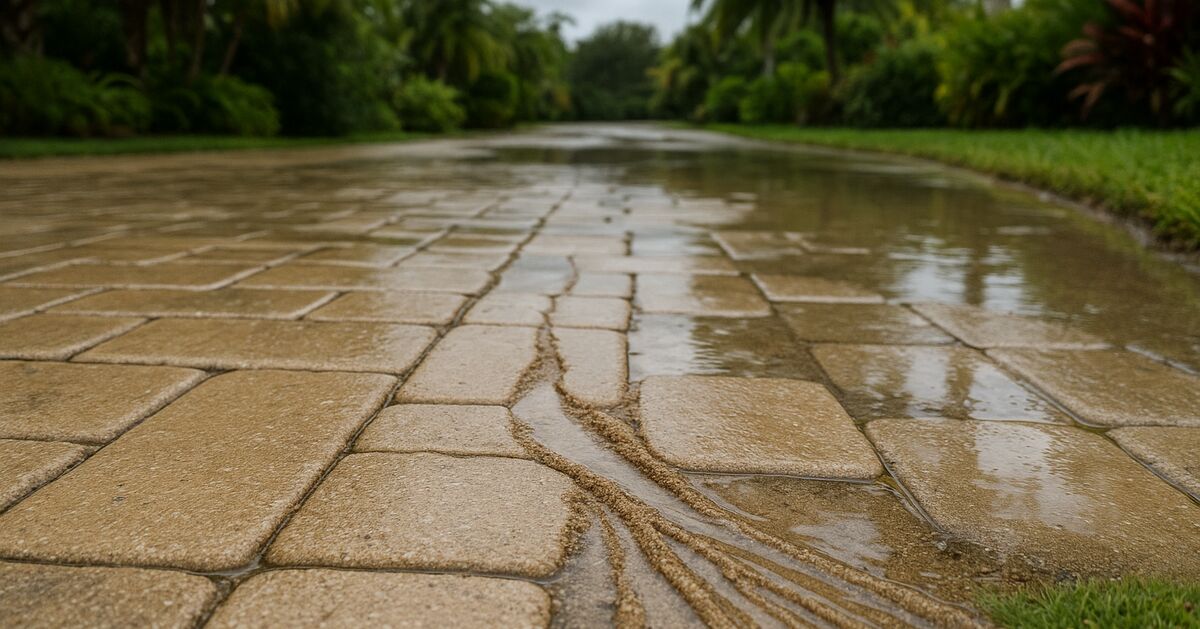
Rain is relentless on the Gulf Coast, and your paver joints pay the price every single season.
If you have ever looked at your driveway or pool deck after a summer storm and noticed thin channels of exposed sand washing across the surface, you are watching one of the most common, and most misunderstood, paver problems in Southwest Florida. Homeowners in Lakewood Ranch, Wellen Park, Sarasota, Bradenton, Venice, Nokomis, Palmer Ranch, and Parrish all deal with it. Most of them sweep new sand back in and call it done. That works for about two weeks. Then the next storm hits and the whole cycle starts again.
This post is going to explain exactly why joint sand washes out so persistently in Florida, what happens to your pavers when it goes, and why professionally applied paver sealing is the one solution that actually breaks the cycle for good.
Why joint sand matters more than most people think
Joint sand, the granular material packed between each paver unit, is not just filler. It is an active structural component. It does three distinct jobs:
- It locks each paver in place laterally. Without firm joint material on all four sides, an individual paver can rock, shift, or rotate under load.
- It distributes weight across the surface. When a car tire or a heavy piece of patio furniture sits on one paver, the surrounding joint sand transfers that load to neighboring units.
- It acts as a flexible buffer. Florida's soils expand and contract slightly with moisture changes. Joint sand accommodates that movement without cracking the pavers themselves.
When that sand is gone, your paver surface goes from a unified, interlocked system to a collection of loose individual tiles sitting on top of soil. That is a fundamentally different, much weaker structure.
The specific reasons Florida is so hard on joint sand
Volume and intensity of rainfall
The Gulf Coast averages somewhere between 50 and 60 inches of rain per year, and a huge proportion of that falls in sudden, intense bursts during the June-through-September rainy season. A half-inch storm that lasts three hours is relatively gentle. A two-inch storm that drops in 45 minutes is a different animal entirely. That kind of flash rainfall overwhelms even well-designed drainage and hits a paver surface with real hydraulic force, loosening sand grains and carrying them away in the runoff sheet.
The Florida sun breaks down organic binders
Most polymeric sand products contain organic binders that give them a degree of cohesion once they have cured. Florida's UV index is among the highest in the continental United States, and that relentless sun degrades organic compounds faster than manufacturers tend to account for in their marketing materials. A polymeric sand installation that holds up for five or six years in Michigan might be largely broken down in two to three years in Sarasota or Venice.
Temperature cycling softens and contracts sand
Daytime summer temperatures on paved surfaces can reach 130 to 150 degrees Fahrenheit in direct sun. Overnight lows are much cooler. That temperature swing, repeated daily for months, causes micro-expansion and contraction in the joint space. Over time it works the sand loose from the sides of the pavers, creating tiny gaps that water exploits on the next rain event.
Irrigation systems accelerate the problem
Most homes in communities like Lakewood Ranch, Palmer Ranch, and Wellen Park run scheduled irrigation systems, often set to run early in the morning several times a week. Those sprinkler heads close to paved surfaces direct a steady stream of water at joint edges, doing exactly the same erosion work as rainfall but in a more targeted, repetitive way. Homeowners often do not connect their irrigation system to the joint sand loss they are seeing, because it happens slowly and the evidence washes away before they notice it.
Foot traffic and vehicle traffic dislodge loosened sand
Once UV and moisture have started breaking down the binder in polymeric sand, normal foot traffic and vehicle movement finish the job. Tires pull sand grains up off the surface and fling them outward. Shoes grind loose particles into smaller fractions that wash away even more easily. The physical disturbance compounds the chemical and hydraulic erosion.
What actually happens when joint sand is gone
The short answer: things start to move that are not supposed to move.
Individual pavers begin to rock. You feel it underfoot as a slight wobble. That wobble means the paver is no longer fully supported, and under repetitive load, the edge of the paver starts digging into the sand base layer beneath it. Once the base is disturbed, the paver can tilt, sink on one side, or drop entirely below grade. Now you have a trip hazard and a water-pooling problem on top of the original sand-loss problem.
Weeds and grass exploit the exposed joints almost immediately. A joint without sand is simply a slot of open soil, and Florida has no shortage of fast-growing, aggressive weeds ready to fill it. Roots from those weeds pry pavers wider apart, which accelerates the whole process.
Water that used to sheet off the surface now channels down through the open joints into the base material. In Parrish and parts of Bradenton where soils have higher clay content, that repeated subsurface wetting and drying causes base erosion and settlement. What started as a sand-loss problem can eventually become a full paver reset, which is a significantly more expensive repair.
For pool decks specifically, open joints allow pool water, chlorine, algae, and sunscreen residue to infiltrate the base, causing staining from below and contributing to the kinds of orange rust staining and surface discoloration we discuss in detail in our post on why pool pavers turn orange or rust-colored on the Gulf Coast.
Why sweeping in new sand is only a temporary fix
Dumping fresh polymeric sand into the joints and wetting it down takes about an hour and feels satisfying. It is also, on its own, a short-term answer.
Here is the problem: you are reintroducing unprotected sand to the same conditions that destroyed the previous sand. The new sand has no barrier between it and Florida's rain, UV, and temperature. Within one to two rainy seasons, you are back to square one. Repeat that cycle a few times and you have spent real money and time on a problem that is still not solved.
The other issue is compaction. When sand first washes out, there is often an air void in the lower portion of the joint even after you re-sweep. If the new sand is not vibrated in properly and the surface is not properly prepared, that void persists, and the paver above it will not be fully supported even though the joint looks full from the surface.
How sealing actually solves the problem
A quality paver sealer, properly applied over correctly installed and compacted joint sand, does something the sand alone cannot do: it bonds the surface of the joint.
When a penetrating or film-forming sealer is applied, it flows down into the top portion of the joint and creates a bonded matrix with the sand particles at the surface. The result is a joint surface that no longer behaves like loose granules. Rain water still flows across the paver surface and into the drainage system, but it cannot pick up and carry away the sealed sand the way it erodes unsealed material.
The specific mechanism depends on the type of sealer:
- Solvent-based sealers penetrate deeply into the paver and into the upper joint, creating a durable, hard bond that resists both hydraulic erosion and UV breakdown.
- Water-based sealers typically form a surface film that caps the joint and prevents water intrusion, though they generally need reapplication sooner than solvent-based products in Florida's climate.
Either way, the sealer is doing something that polymeric sand alone cannot: it is creating a continuous, water-shedding surface that treats the joint as part of the overall sealed system rather than as an unprotected gap.
There is an important sequence here that matters enormously. The joint sand must be properly installed and fully settled before sealing. Sealing over sand that has not compacted fully, or over sand that is still damp, traps moisture below the sealer and can cause hazing or efflorescence. If you have ever seen that chalky white residue on pavers after sealing, you know how frustrating that is, and our post on why pavers turn white after sealing explains exactly why that happens and how professionals avoid it.
What the professional process looks like
A proper joint-sand-and-seal job is not a one-afternoon DIY project in Florida conditions. Here is what a knowledgeable contractor does:
- Inspect the joints before any work begins. If sand loss is severe, or if pavers are already rocking, the base may need evaluation before anything is added on top.
- Clean the surface thoroughly. Organic material, algae, and any residue left in the joints will prevent the new sand and sealer from bonding properly. In Florida's humidity, this step is non-negotiable.
- Blow out or vacuum the joints to remove loose material and any organic debris at the bottom of the joint channel.
- Install fresh polymeric sand and work it fully into the joints with a plate compactor. Multiple passes matter here. A single sweep rarely fills joints completely.
- Allow the sand to fully cure before applying sealer. The specific wait time depends on the sand product, humidity, and temperature. Rushing this step is one of the most common causes of sealing problems.
- Apply sealer in proper conditions. In Southwest Florida, that typically means morning applications when temperatures are rising, surfaces are dry, and afternoon rain is less likely. Humidity and surface temperature windows matter.
Our paver sealing and restoration services include all of these steps as part of a complete process, not as upsells to a basic wash-and-spray job.
What to watch for on your own property
You do not need to be a contractor to spot early joint sand problems. Walk your driveway, patio, or pool deck after the next heavy rain and look for:
- Sand deposits collecting in low spots or along the edges of the paved area
- Visible gaps at the edges of pavers where the joint has dropped below the paver surface level
- Rocking pavers underfoot, even subtle movement
- Weed growth along joint lines, which almost always signals that sand has dropped enough to expose soil
- Pooling water in spots that used to drain cleanly
Any of these signs mean the joint system is compromised and the problem will accelerate without intervention. The earlier you address it, the less base repair is involved, and the lower the overall cost.
What about sealed pavers that still lose sand?
Sealed pavers can still experience joint sand loss if the sealer has aged past its useful life. Sealers do not last forever, especially in Florida's UV and rain environment. A surface sealed five or six years ago may have a sealer that has largely broken down, leaving the joints exposed again. In this situation, the fix is the same as for an unsealed surface: clean, re-sand, and reseal.
If you are unsure whether your existing sealer is still functional, try the water bead test. Sprinkle a small amount of water on the surface. If it beads up and rolls off, the sealer is working. If it soaks in immediately, the sealer is gone. Homeowners across our service areas regularly use this simple test to decide whether it is time to call for an inspection.
Local conditions to keep in mind
Every community on the Gulf Coast has its own microclimate factors. In Nokomis and Venice, salt air from the Gulf adds an additional layer of chemical stress to both the sand binder and the sealer. In Parrish and parts of Bradenton, soils with higher iron content mean that open joints can develop rust staining faster than in other areas. In Wellen Park and Lakewood Ranch, newer communities with newer paver installations sometimes have sand that was never fully compacted by the original installer, meaning the joints were vulnerable from day one.
Our Lakewood Ranch paver sealing and restoration team and our Wellen Park paver sealing and restoration team both frequently find joint sand issues that trace back to the original installation rather than to wear and tear. Getting it right now prevents much more expensive problems later.
The bottom line
Sweeping sand back into your paver joints after every storm is a reasonable short-term response to an immediate problem. But it is not a solution. Florida's rainfall intensity, UV exposure, heat cycling, and irrigation systems will keep destroying unprotected joint sand for as long as you own the property.
Professionally installed, properly timed paver sealing creates a durable bond over the joint surface that resists the specific conditions Southwest Florida throws at pavers all year long. It is the step that converts a temporary patch into a lasting repair.
If your joints are showing any of the warning signs described above, the most useful next step is an in-person look. Get in touch with our team and we will take a look at your pavers, assess the joint condition, and give you an honest picture of what it will take to stop the sand loss for good.
Get started
Request a free quote
Tell us what you need. No pressure, and a real person gets right back to you.