
Why travertine pool decks need a different sealer than concrete pavers
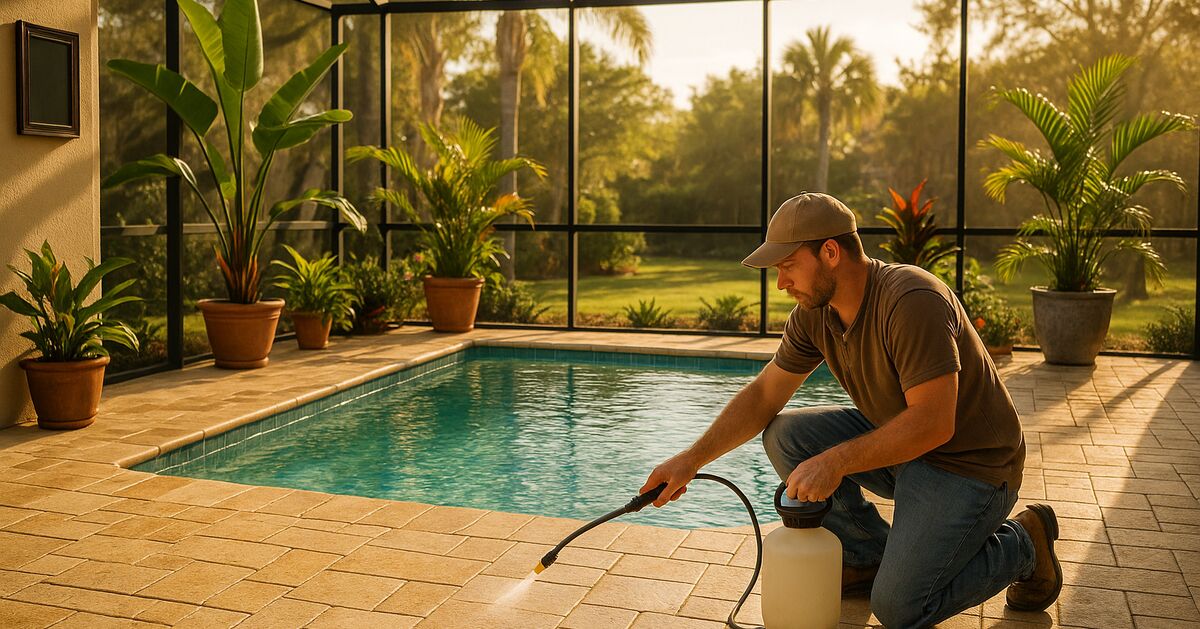
Travertine pool decks look effortlessly elegant around a Florida pool, but that beauty comes with a catch: travertine is a fundamentally different material than the concrete pavers most Florida homes are built with, and sealing it the same way is one of the more expensive mistakes a homeowner can make.
This is not a minor product-selection detail. The wrong sealer can trap moisture inside the stone, cause the surface to cloud over, accelerate spalling, or turn a breathable natural material into a slick, film-covered surface that is genuinely hazardous around water. We see the consequences of this choice regularly on pool decks across Sarasota, Venice, Lakewood Ranch, and Nokomis, so it is worth spending real time on the why.
Travertine is limestone, not concrete - and that matters chemically
Concrete pavers are manufactured products: portland cement, aggregate, pigment, and water, pressed and cured into a dense, relatively uniform tile. Travertine is quarried limestone, formed over thousands of years by mineral-rich spring water depositing calcium carbonate in layers. The resulting material is beautiful and durable, but it has two properties that make it behave very differently from concrete when you apply a sealer.
It is alkaline. Travertine is generally alkaline, with a pH typically above 7. Certain acrylic and polyurethane sealers, particularly solvent-based film-forming products designed for concrete, can react with the calcium carbonate in the stone. That reaction can cause milky discoloration, surface peeling, or a stubborn haze that is very difficult to remove without a stripping product.
It is porous and breathable by nature. Natural travertine has a network of small voids and channels running through it. That is actually part of its thermal advantage around pools: it stays cooler underfoot than concrete in direct sun, partly because those voids allow air movement and reduce heat absorption. A film-forming sealer, the kind that sits on top of the surface and creates a visible sheen, can seal those voids shut. When Florida's afternoon rain hits a hot deck, or when groundwater moves beneath the slab, there is nowhere for the vapor to go. It forces its way through the stone from underneath, and the trapped pressure is what causes the sealer to bubble, peel, and flake.
Film-forming sealers vs. penetrating sealers: the core difference
Every paver and stone sealer falls into one of two broad categories, and this distinction is the key to understanding why travertine demands a specific approach.
Film-forming sealers (also called topical sealers) deposit a protective coating on top of the material. They create a visible sheen, range from satin to high-gloss, and they work well on dense concrete pavers that have low natural porosity. The film bonds to the surface, repels water and stains, and can be renewed over time. For a concrete paver driveway in Bradenton or Parrish, a quality film-forming acrylic sealer is often exactly the right tool.
Penetrating sealers (also called impregnating sealers) soak into the stone rather than sitting on top of it. The active chemistry, usually a silane, siloxane, or fluoropolymer compound, bonds with the mineral structure below the surface and repels water and oil from within. The surface looks essentially the same after application: same color (or slightly enhanced), same texture, no sheen unless you specifically choose an "enhancing" formula. The material can still breathe, meaning vapor can escape rather than build up.
Travertine needs a penetrating sealer. That is the short answer. The longer answer is why, and what happens in Florida's specific climate when that rule is ignored.
Why Florida's climate turns a bad sealer choice into a disaster faster
Homeowners in Wellen Park, Palmer Ranch, and elsewhere on the Gulf Coast are dealing with a climate that is genuinely punishing on outdoor surfaces. A few factors combine to accelerate any sealer-related problem.
Thermal cycling. Daytime temperatures in the Sarasota and Manatee County area regularly push into the 90s from May through September. Travertine decks in direct sun can reach very high surface temperatures during Florida summers. A film-forming sealer expands and contracts with those temperature swings. Over time, that cycling causes micro-cracks in the film, which let water in but do not let it back out easily.
Humidity and afternoon rain. Southwest Florida's rainy season brings daily moisture that hits surfaces quickly and soaks in before it can evaporate. If a film-forming sealer is trapping that moisture inside the stone, you are essentially running a slow pressure test on the bond between the sealer film and the travertine surface every afternoon from June through September.
Pool water chemistry. Chlorinated water, and especially saltwater pool systems, are moderately acidic. Per guidance from the Pool & Hot Tub Alliance, typical pool water is maintained at a pH of 7.2 to 7.8, which means it is slightly acidic relative to travertine's natural alkalinity. Splashout hitting a travertine deck repeatedly over a season slowly works on the surface. If a film-forming sealer has been used and has begun to crack or peel, those micro-openings become pathways for pool water to work its way under the film and accelerate delamination.
Ground moisture. Many pool decks in this region sit over soil that holds significant moisture. Vapor migrating up through the slab has to go somewhere. A penetrating sealer lets it pass. A film-forming sealer stops it, and the result, over months, is bubbling and lifting from below.
What actually happens when you use the wrong sealer on travertine
Here is a practical breakdown of the failure modes we encounter on travertine decks that have been sealed with a product designed for concrete pavers.
- Milky or white haze. This is a pH reaction or moisture entrapment issue. The film turns opaque in patches or across the whole surface. It looks similar to efflorescence but has a different cause and requires a different fix.
- Bubbling and blistering. Vapor pressure building beneath a sealed surface pushes the film up in domes. Once they pop, you are left with flaking, rough patches that collect dirt and algae.
- Peeling and delamination. Full sections of the sealer film lift away, especially at the grout joints between tiles where moisture is most active. The exposed stone underneath may have been chemically altered during the time it was sealed.
- Increased slipperiness. A high-gloss film-forming sealer on travertine around a pool creates a surface that becomes dangerously slick when wet. This is a genuine safety concern. Travertine's natural texture is one of its best safety features around pools; covering it with a film strips that away. (Our related post on why travertine pavers pit, flake, and powder covers other ways that sealer missteps damage this stone.)
- Stripping difficulty. Removing a film-forming sealer that has bonded poorly to travertine is significantly harder than removing one that has bonded well. The patches that are still adhering require chemical strippers, and those strippers have to be chosen carefully to avoid etching the limestone underneath. As we cover in detail in our post on when old sealer clouds or traps moisture, stripping is not a simple pressure wash. On travertine, it is even more involved.
What a correct sealer for travertine looks like
A quality penetrating sealer for travertine pool decks will typically have these characteristics.
- Silane-siloxane or fluoropolymer chemistry. These molecules are small enough to penetrate into the stone's pores rather than sitting on top. Once cured, they line the pores and repel water and oil without sealing the pores shut.
- Vapor permeable ("breathable"). The product label or technical data sheet should confirm vapor permeability. This is the single most important specification for travertine in a wet environment.
- pH neutral formulation. To avoid reacting with the calcium carbonate in the stone.
- Wet-look or color-enhancing options available, but used with care. Some penetrating sealers include a mild color-enhancing component that deepens the travertine's natural tones. These are generally fine for travertine as long as they remain penetrating rather than film-forming. A pure natural-look formula is the safest default.
- Slip-resistant in wet conditions. Since the product is not adding a film, the travertine's natural texture is preserved. That is the desired outcome around a pool.
The cleaning and prep step that most owners underestimate
No sealer, penetrating or otherwise, performs well on a dirty or compromised surface. Travertine pool decks collect algae, calcium deposits from hard water, sunscreen residue, and tannin stains from poolside vegetation. A thorough cleaning before sealing is not optional.
For travertine, the cleaning chemistry matters. Pressure washing alone is rarely sufficient, and the wrong chemical cleaner can etch the surface. Acidic cleaners commonly used on concrete (including some off-the-shelf "paver cleaners") will attack the calcium carbonate in travertine. A pH-neutral or mildly alkaline stone cleaner is the appropriate choice, applied at low pressure to avoid driving contaminants deeper into the pores.
Existing sealer, if present, needs to be fully removed before applying a new penetrating sealer. You cannot penetrate through a film. Even a degraded film-forming sealer will block enough of the surface to prevent proper penetration, leaving you with uneven protection and a patchwork appearance.
Frequency: how often does travertine actually need resealing?
A properly applied penetrating sealer on travertine in the Gulf Coast climate generally needs reapplication after a few years, depending on sun exposure and cleaning frequency. The wide range reflects several variables: how much direct sun the deck receives, whether it is under a screen enclosure, how frequently the surface is cleaned, and the quality of the original sealer product.
A simple field test: pour a small amount of water on the surface and watch what it does. If it beads and sits on top, the sealer is still active. If it absorbs quickly and darkens the stone, the sealer has depleted and it is time to reseal. This test works reliably on penetrating sealers. If the deck has a film-forming sealer on it, the water behavior tells you about the film, not about the stone underneath.
What to ask a contractor before they seal your travertine deck
A handful of direct questions will help you tell apart contractors who know travertine from those who treat all pavers the same way.
- What specific product are you using, and is it a penetrating or film-forming sealer?
- Is this product vapor permeable?
- What is the cleaning process, and what chemistry are you using on the stone?
- If there is existing sealer, how will you remove it before applying the new product?
- What sheen level will the finished surface have?
If the contractor proposes a high-gloss acrylic sealer without any conversation about the difference between travertine and concrete, that is a meaningful warning sign. The services we provide are built around material-specific approaches precisely because the wrong sealer choice costs homeowners significantly more to fix than the original job was worth.
Local specifics for Gulf Coast travertine decks
Travertine pool decks are common throughout the communities we serve. In Lakewood Ranch, many of the larger custom homes and move-up builds include travertine as a standard pool deck finish. In Venice and Nokomis, where older homes are being renovated, we often encounter travertine that has been maintained inconsistently or sealed with whatever product a previous owner had on hand.
The screen enclosures common throughout Sarasota and Bradenton partially reduce UV and rain exposure, but they do not eliminate moisture. Screened travertine decks still need penetrating sealers and still need periodic reapplication. The enclosure simply extends the interval slightly.
If you are not sure what is currently on your travertine, or what was applied by a previous owner or contractor, that is the right starting point for any conversation with us. You can reach out through our contact page and we will walk through what you are seeing on the surface and what the right next step looks like for your specific deck.
For a broader look at how we approach every material across the region, our full services overview and locations page lay out what to expect from an initial assessment through finished sealing.
Travertine deserves to be treated like the natural stone it is. When it is, it lasts beautifully in the Florida climate for decades. When it is not, the repair costs are a frustrating reminder of why material knowledge matters before the first drop of sealer hits the stone.
Sources & further reading
- Natural Stone Institute - Care and Maintenance of Natural Stone (Natural Stone Institute)
- Pool & Hot Tub Alliance - Pool Water Chemistry Guidelines (Pool & Hot Tub Alliance)
- EPA - Silane and Siloxane Water Repellent Penetrating Sealers Overview (U.S. Environmental Protection Agency)
- USGS - Limestone and Travertine Mineral Resources (U.S. Geological Survey)
- Florida Building Code - Exterior Deck Surface Requirements (Florida Building Commission)
Claim-by-claim audit (5 checked)
- “Travertine is generally alkaline, with a pH typically above 7.” (rewritten to what the article can stand behind)
- “Travertine decks in direct sun can reach very high surface temperatures during Florida summers.” (rewritten to what the article can stand behind)
- “Per guidance from the Pool & Hot Tub Alliance, typical pool water is maintained at a pH of 7.2 to 7.8, which means it is slightly acidic relative to travertine's natural alkalinity…” (cited → phta.org)
- “Increased slipperiness. A high-gloss film-forming sealer on travertine around a pool creates a surface that becomes dangerously slick when wet.” (reasoning shown in the article)
- “A properly applied penetrating sealer on travertine in the Gulf Coast climate generally needs reapplication after a few years, depending on sun exposure and cleaning frequency.” (rewritten to what the article can stand behind)
Get started
Request a free quote
Tell us what you need. No pressure, and a real person gets right back to you.