
What Does Paver Sealing Cost in Sarasota & Manatee County? (2026 Guide)
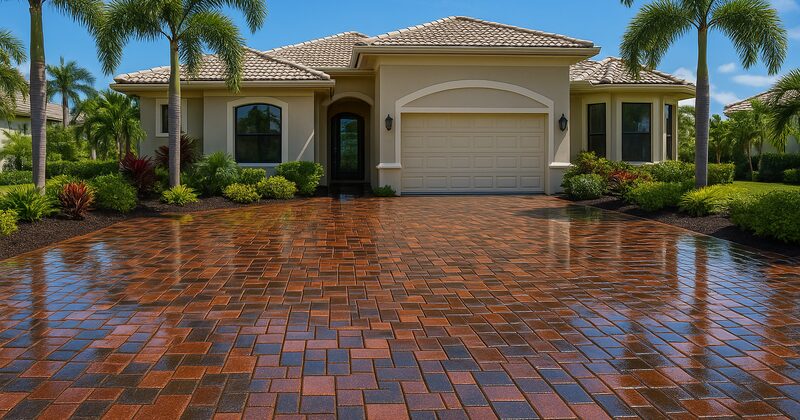
Here in Sarasota and Manatee County, most paver sealing jobs land in the range of about $1 to $3 per square foot. That means a standard paver driveway typically runs somewhere from around $750 to $4,500, and a pool deck or lanai from about $875 to $6,000, depending on size and condition. Below we break down honestly what moves the price inside those ranges, why the cheapest quote is rarely the cheapest job, and what a complete, no-surprises quote should actually include.
The short answer on paver sealing cost
If you want the numbers up front, here they are again, plain and simple:
- Per square foot: most jobs land around $1 to $3 per square foot.
- Paver driveway: typically $750 to $4,500.
- Pool deck or lanai: typically $875 to $6,000.
The spread inside each of those ranges is wide on purpose, because a small, clean, well-maintained surface and a large, weathered, previously-sealed one are two very different jobs. Two homes on the same street in Lakewood Ranch can get quotes that differ by thousands, and both can be completely fair. What matters is understanding what drives your number, so you can tell a real quote from a lowball that will cost you more later.
The final price always comes down to size and condition. Nobody can give you an honest figure sight-unseen, which is why we measure the surface, look at what shape it is in, and hand you a firm written price before any work begins.
What drives the price within the range
Three things move your quote up or down inside those per-square-foot bands. When you understand them, the number on your quote stops feeling like a mystery.
1. Square footage
This is the most obvious factor. More area means more cleaning, more sand, more sealer, and more labor hours. A compact walkway and a sprawling circular driveway are not the same job, and the price scales with the space. Larger jobs sometimes earn a slightly better per-foot rate because we are already mobilized on site, but the total still climbs with size.
If you are trying to estimate your own project before we visit, measure the length and width of each paved area and multiply to get square footage. Multiply that by $1 to $3 and you will have a rough ballpark. Just remember it is only a starting point until we see the condition of the surface.
2. How much cleaning and joint re-sanding the surface needs
Sealer only performs as well as the prep underneath it. A deck that has gone green with algae, or a driveway with washed-out joints and weeds pushing through, needs more work before a drop of sealer goes down. In our climate, joint sand gets driven out by heavy summer rain, so most surfaces need to be re-sanded with polymeric sand to lock the pavers back together. That prep is most of the labor on a good job.
A surface that has been maintained on schedule and only needs a light clean and touch-up will sit at the lower end of the range. One that has been neglected for years, with heavy organic growth, stains, and empty joints, needs a deep paver cleaning and full re-sanding, which pushes it higher. This is why condition matters as much as size.
3. Whether old failed sealer has to be stripped first
This is the big one, and it is the factor most homeowners do not see coming. If your pavers were sealed before and that old coating has clouded, hazed, peeled, or turned tacky, it cannot simply be sealed over. The failed sealer has to be chemically stripped off first, the pavers neutralized and fully dried, and only then can a fresh coat go on correctly.
Sealer stripping adds real labor and material to a job, and it is the single most common reason one quote is meaningfully higher than another. A company that ignores the old sealer and seals right over it will quote you less, but you will be paying twice when that new coat fails too. If your surface has ever been sealed, ask any company you talk to how they are handling the existing coating.
Why a suspiciously cheap quote often costs more
We get a lot of calls in Sarasota and Manatee County from homeowners who hired the cheapest bidder and are now paying us to fix it. A rock-bottom quote is almost always cheap because something important was left out. Here is what usually gets skipped to hit that price:
- Thin, single-coat work. Proper coverage often takes more than one coat, especially on porous or sun-faded pavers. A single skimpy coat looks fine for a few weeks, then fades and fails fast.
- Skipped or rushed cleaning. Sealing over mold, algae, and grime just locks the dirt in permanently. It saves the crew an afternoon and costs you the whole job, because it has to be stripped and redone.
- No joint re-sanding. If the joints are not refilled with polymeric sand, the pavers stay loose, weeds and ants come right back, and sand keeps washing out with every storm.
- The wrong sealer. Using a cheap or mismatched product, or a topical paver sealer on natural stone like travertine, causes hazing, peeling, and trapped moisture. Fixing that means stripping everything off and starting over.
The pattern is always the same. The low quote wins the job, the work fails within a year or two, and then the surface needs a full paver restoration plus stripping and re-sealing. You end up paying for the job twice, and living with a blotchy deck in between. Cheap is rarely cheap in this business. It is usually just deferred.
What a real, complete quote should include
You should never have to guess what you are paying for. A proper written quote from any reputable company in our area should spell out the whole job, not just a lump sum. Ours always does, and yours should too. Look for these line items:
- Cleaning. The deep clean, plus treatment for any algae, mold, rust, or stains, and stripping of old sealer if present.
- Joint re-sanding. Fresh polymeric sand swept in and set to lock the pavers and keep weeds and ants out.
- The sealer product and number of coats. Which sealer, what finish (matte, low-sheen, or wet-look), and how many coats are included.
- A firm written price before work starts. The full number agreed in writing up front, with no surprise add-ons when the crew is finishing up.
That last point is the one that protects you most. We give every customer a firm written quote before we start, and the price we write down is the price you pay. If a quote is vague about prep, dodges the question of old sealer, or leaves the coat count unstated, that is your signal to ask more questions. Our FAQ walks through more of what to expect, and you are always welcome to call and have us explain any line on your estimate.
DIY versus hiring a pro
Sealing pavers yourself is possible, and for a small, simple surface some homeowners do it well. But it is worth being honest about the costs and the risks before you rent a machine and buy a bucket of sealer.
The DIY math. Quality sealer is not cheap, and you need enough for proper coverage, which often means more than one coat. Add a pressure washer or surface cleaner rental, polymeric sand, and a full weekend of hard physical work in Florida heat. By the time you add it up, the material-and-rental cost on a mid-size surface eats into the savings more than people expect.
The real risks. The two mistakes we see most from DIY jobs are trapping moisture and applying unevenly. Seal pavers that are not fully dry, or seal too heavily, and you trap moisture under the coating, which turns it white and cloudy. That haze does not clear on its own. It has to be stripped and redone. Applying unevenly leaves blotchy, streaky patches and shiny spots. And using the wrong product for your surface, especially on travertine, causes flaking and peeling.
When a DIY seal goes wrong, the fix costs more than hiring a pro would have in the first place, because now the surface needs stripping before it can be redone. If your project is a large driveway sealing job or a pool deck sealing job where slip resistance and a wet, high-traffic environment are in play, that is where professional prep and the right sealer really earn their keep.
Budgeting for the long run
The one thing we always want homeowners to understand is that paver sealing is not a one-and-done purchase. It is a recurring maintenance item, like painting a house or servicing an AC. In our Gulf-coast climate, with intense sun, heavy summer rain, and year-round humidity feeding algae, sealer breaks down faster than it does up north. Most surfaces here need resealing every couple of years, and we cover the timing in detail in our guide on how often to reseal pavers.
That is not a reason to skip it. It is a reason to budget for it. When you plan for a modest reseal every two to three years, each cycle is a light maintenance clean and a fresh coat, which sits at the lower, cheaper end of the range. It is when a surface gets neglected for many years that it slides into the expensive end, needing full restoration, stripping, and heavy cleaning to bring it back. Staying on a maintenance rhythm is genuinely the cheapest way to own pavers over time. Homeowners across Sarasota, Bradenton, and the surrounding communities who keep their decks and driveways on a simple cycle spend less over ten years than those who let it all go and pay for one big rescue job.
Ready for an honest number on your project?
Every property is different, and the only way to give you a real figure is to look at your pavers, measure the space, and check the condition. There is never any pressure and never an obligation. We will tell you honestly what your surface needs, and if it does not need sealing yet, we will tell you that too.
When you are ready, request a free written quote at /#get-a-quote, and we will give you a firm price before any work begins, with no surprises at the end.
Get started
Request a free quote
Tell us what you need. No pressure, and a real person gets right back to you.